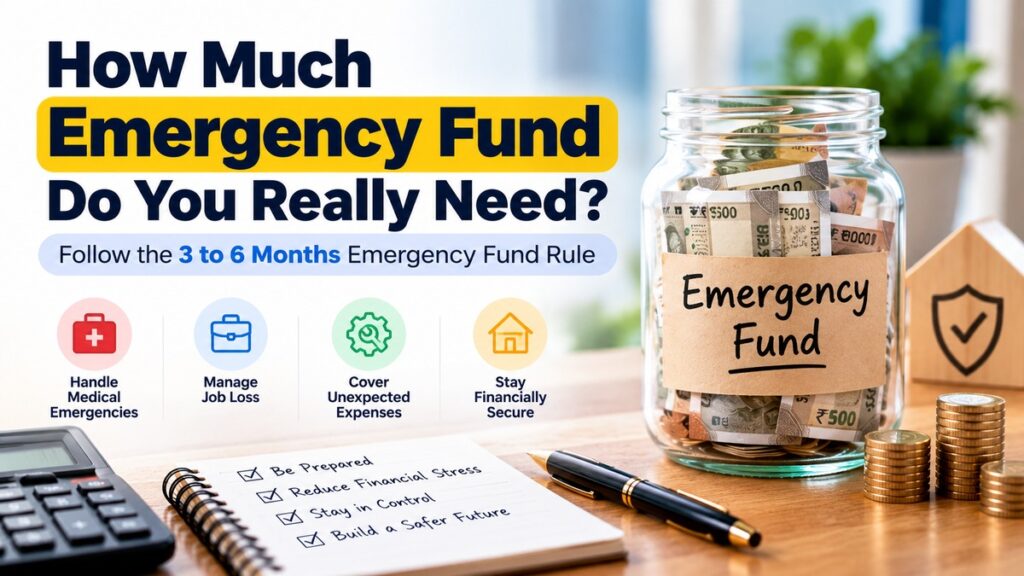
Imagine your salary stops arriving tomorrow, but rent, groceries, electricity and EMIs do not stop with it. The 3 to 6 Months Emergency Fund Rule helps you build a financial buffer for a job loss, urgent medical bill or essential repair. This 3 to 6 Months Emergency Fund Rule is a practical starting point for protecting your household when income changes unexpectedly. Start by reviewing your monthly needs with the Stock Charcha calculators and use the simple planner below to estimate a target that fits your situation.
The video introduces the emergency fund rule, how to estimate essential expenses and where accessible savings may fit.
What Does the 3 to 6 Months Emergency Fund Rule Actually Mean?
The 3 to 6 Months Emergency Fund Rule is a practical starting point: build savings equal to three to six months of essential living expenses. It is not three to six months of salary, and it is not money earmarked for a holiday, a new phone or a planned purchase. When people ask what the 3 to 6 Months Emergency Fund Rule means, the key detail is that the target is based on essential costs, not every rupee you usually spend. The target is based on what you would need to keep your household running if income suddenly fell or an unavoidable bill arrived. This emergency fund is separate from money set aside for planned annual expenses.
Why not keep it all invested? An emergency can arrive when markets are down, forcing you to sell at a loss. The 3 to 6 Months Emergency Fund Rule prioritises access and resilience over maximising returns. Stock Charcha helps readers test financial ideas with numbers instead of treating the 3 to 6 Months Emergency Fund Rule as a one-size-fits-all instruction. Stock Charcha helps readers test financial ideas with numbers instead of treating a rule as one-size-fits-all.
Which Expenses Should You Count When Calculating Your Target?
To apply the 3 to 6 Months Emergency Fund Rule, list the bills you would still have to pay during a difficult month. This makes your emergency fund target more realistic than using your full salary as the calculation base. Include rent or essential home costs, basic groceries, utilities, necessary transport, insurance premiums, medicines, school fees that cannot be paused and minimum required loan or EMI payments. Use a realistic monthly amount, not an unusually frugal month that you could not sustain.
Separate essentials from costs you could temporarily reduce, such as restaurant meals, subscriptions, non-urgent shopping, holidays and upgrades. Include some flexible spending only if cutting it would be unrealistic for your household.
How Can You Estimate an Emergency Fund Target?
Enter your essential monthly expenses and choose the number of months you want to cover. The calculator puts the 3 to 6 Months Emergency Fund Rule into practice using your own estimated costs. The result is an illustrative target based on your inputs, not a guarantee that every possible emergency will be covered.
If essentials cost ₹15,000 a month, three months equals ₹45,000 and six months equals ₹90,000. At ₹35,000 a month, a six-month target is ₹2.1 lakh. These examples are illustrative; update them when your rent, debt, income or family responsibilities change.
Should You Aim for Three Months or Six Months of Expenses?
Three months may be a first milestone if you have stable employment, low fixed obligations and dependable support. Six months or more may suit freelancers, contract workers, people with dependants or anyone whose income could take longer to recover. The 3 to 6 Months Emergency Fund Rule offers a range because risks differ; it is a planning guide, not a rigid requirement that suits every household.
| Your situation | Possible starting target | Why consider it? |
|---|---|---|
| Stable income, low obligations | 3 months | A first buffer while you build the habit |
| One main earner or dependants | 6 months | More time to manage an income disruption |
| Freelance or irregular earnings | 6 months or more | Income may vary and take longer to recover |
This is a planning guide, not a formal standard. Review your target periodically. If you have expensive debt or no savings, do not let the full amount discourage you; a smaller starter fund is still progress.
How Can You Build an Emergency Fund Without Feeling Stuck?
To follow the 3 to 6 Months Emergency Fund Rule without feeling overwhelmed, choose a first milestone such as ₹10,000 or one month of essential expenses. Set an automatic transfer shortly after payday into a separate account, even if the first transfer is only ₹500 or ₹1,000. Increase it when you receive a raise, finish an EMI or reduce a recurring expense. Consistency matters more than waiting for a perfect month.
If money is tight, reduce optional spending and direct part of a bonus, tax refund, gift or freelance payment toward savings. Avoid treating every spare rupee as investable before you have a basic cash buffer. Build in stages that fit your cash flow.
Compare this with the 50:30:20 budgeting rule, and adjust its suggested split to your actual essential costs.
Where Should You Keep an Emergency Fund So You Can Access It?
The 3 to 6 Months Emergency Fund Rule works best when the money is easy to access without depending on market conditions. A separate savings account can help you avoid accidentally spending the money and can provide quick access for urgent bills. Keep enough immediately available to cover near-term needs, remembering that ATM, transfer and bank limits may apply.
Some people consider fixed deposits or liquid mutual funds for part of the balance. Fixed deposits may have premature-withdrawal conditions or penalties; mutual funds are market-linked, with scheme-specific risks and redemption timelines. Do not assume any product is risk-free or instantly accessible. Check official terms first.
Avoid putting the entire fund into shares, cryptocurrency, gold or property: values fluctuate and sales may take time. The 3 to 6 Months Emergency Fund Rule prioritises access over chasing returns. Check official product details and the SEBI website for investor education.
What Mistakes Can Make an Emergency Fund Less Useful?
- Using salary instead of essential expenses: this can make the target unnecessarily high or too low for your actual bills.
- Keeping it mixed with everyday spending: a separate account can make the boundary clearer.
- Investing the entire amount in volatile assets: emergency money should not depend on selling during a market fall.
- Never replenishing it: if you use the fund for a genuine emergency, make rebuilding it part of your next budget.
- Waiting until you can save the full target: build it in stages, starting with a modest buffer.
Use your emergency fund for genuine urgent needs, such as a job interruption, necessary medical expense or essential repair—not predictable annual bills you could plan for separately. Once you use it, review the event and update your target if it exposed a gap in your plan.
Can You Test Your Emergency Fund Knowledge?
Try five questions selected at random from this topic’s question bank. Refresh the page or choose “New Questions” to get another set.
How Can You Keep Improving Your Financial Safety Net?
Review the target after a new child, move, loan or job change, and check every few months that the money remains accessible.
Stock Charcha encourages a numbers-first approach: list expenses, test timeframes and build steadily. The 3 to 6 Months Emergency Fund Rule is meant to give you more choices when life changes unexpectedly. Revisit your 3 to 6 Months Emergency Fund Rule target whenever your essential bills, family responsibilities or income stability change.
What Can You Explore Next on Stock Charcha?
Continue learning with these resources and use the most relevant tools as your financial plan develops.
Educational note: This article is for general education, not personalised financial or investment advice. Stock Charcha is not a SEBI-registered investment adviser. Savings and investment products have different risks, terms and access conditions; verify current details with official providers and consider a qualified financial professional for advice about your circumstances.