Table of Contents
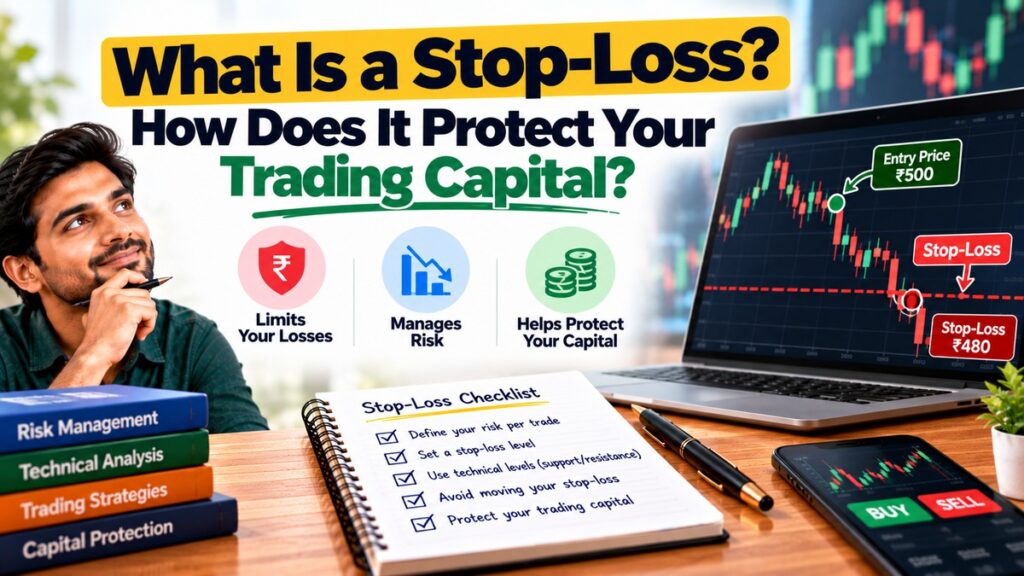
Imagine buying a stock at ₹500, expecting its price to rise. Instead, the price falls to ₹470, then ₹450. Without a clear exit strategy, you might continue holding the stock, hoping it will recover. This is where understanding what is a stop-loss becomes important.
A stop-loss helps traders establish an exit level before entering a trade. It is a risk management tool designed to help limit potential losses when the market moves against a position.
At Stock Charcha, we simplify stock market concepts to help Indian investors and beginners understand trading strategies, risk management, and market fundamentals. In this guide, you will learn what a stop-loss is, how it works, how to calculate a stop-loss price, and which mistakes to avoid.
What Is a Stop-Loss in the Stock Market?
A stop-loss is an order or predefined exit instruction that activates when a stock reaches a specified trigger price. Its primary purpose is to help traders manage potential losses by following a planned exit strategy instead of making emotional decisions.
For example, suppose you purchase 20 shares at ₹500 each and set a stop-loss trigger at ₹480. If your order executes at ₹480, your loss would be ₹400 before brokerage and other charges.
Understanding what is a stop-loss also means knowing its limitations. Market gaps, low liquidity, and sudden price movements can cause an order to execute at a different price than expected.
How Does a Stop-Loss Work?
A stop-loss works by linking your exit decision to a predetermined price level.
Consider this example:
| Trading Detail | Example |
|---|---|
| Buying price | ₹500 |
| Stop-loss trigger price | ₹480 |
| Number of shares | 20 |
| Planned loss per share | ₹20 |
| Potential loss before charges | ₹400 |
If the stock reaches ₹480 and your sell order executes at that price, your loss would be ₹400. However, if negative news causes the stock to open at ₹465, the final execution price may be lower than your intended trigger.
If you are learning how to trade, explore our guide on how to do intraday trading to understand how traders plan entries and exits.
What Are the Different Types of Stop-Loss Orders?
Traders may use different types of stop-loss orders depending on their strategy, broker, and available order features.
| Type | How It Works | Main Consideration |
|---|---|---|
| Stop-loss market order | Triggers a market order when the specified price is reached | Execution price may differ from the trigger |
| Stop-loss limit order | Triggers a limit order at a specified price | The order may not execute |
| Trailing stop-loss | Adjusts the exit level as the price moves favourably, according to its rules | Availability and behaviour depend on the broker |
A stop-loss market order generally prioritises execution after activation, subject to available liquidity. A stop-loss limit order provides greater price control but may remain unexecuted if the market moves beyond the limit.
A trailing stop-loss can help traders manage risk as a position moves in their favour. Before using any order type, check your broker’s instructions and applicable exchange rules.
How Do You Calculate a Stop-Loss Price?
To calculate a stop-loss for a long trade, subtract your planned loss per share from the buying price.
Formula:
Stop-loss price = Buying price − Planned loss per share
For example, if you purchase a stock at ₹800 and decide to risk ₹40 per share:
₹800 − ₹40 = ₹760
Your stop-loss price would be ₹760, representing a planned price difference of 5% from your entry price.
You can use the Stock Charcha Stop-Loss Calculator to calculate stop-loss levels based on your inputs.
You may also find the Position Size Calculator useful for understanding how share quantity affects potential losses.
Remember that the stop-loss price alone does not determine your total risk. The number of shares you purchase also affects the amount you could lose.
How Should You Choose the Right Stop-Loss Level?
There is no single stop-loss percentage that works for every stock or trading strategy. The appropriate level depends on the stock’s volatility, your entry price, market conditions, and risk tolerance.
Consider these factors when choosing a stop-loss:
- Stock volatility: Highly volatile stocks may experience larger price fluctuations.
- Trading strategy: Intraday and positional trades may require different exit plans.
- Risk tolerance: Decide how much you can afford to lose before entering the trade.
- Position size: Match the quantity traded to your planned risk.
- Market conditions: Consider liquidity, sudden price movements, and overnight gaps.
Use the Risk-Reward Ratio Calculator to compare your planned risk with your potential reward.
You should also understand the golden rule for stop-loss before developing your own trading approach.
What Is the Difference Between a Stop-Loss and a Target Price?
A stop-loss and a target price serve different purposes in a trading plan.
| Feature | Stop-Loss | Target Price |
|---|---|---|
| Main purpose | Manage potential losses | Identify a potential profit-taking level |
| Position in a long trade | Usually below the entry price | Usually above the entry price |
| Primary benefit | Defines an exit condition for adverse price movements | Establishes a potential profit objective |
| Guaranteed outcome? | No | No |
For example, suppose you buy a stock at ₹500, set a stop-loss at ₹480, and choose a target price of ₹540. Your planned risk is ₹20 per share, while your potential reward is ₹40 per share before charges.
This represents a planned risk-reward ratio of 1:2. Actual results may differ due to execution prices and market movements.
What Common Stop-Loss Mistakes Should You Avoid?
Even when you understand what is a stop-loss, mistakes in applying it can weaken your risk management.
1. Trading without an exit plan: Decide your stop-loss level before entering the trade.
2. Moving the stop-loss further away: Widening the stop repeatedly to avoid booking a loss can increase your exposure.
3. Ignoring position size: A suitable stop-loss cannot compensate for a position that is too large. Use the Stock Profit and Loss Calculator to estimate potential outcomes.
4. Assuming execution at the trigger price: Market gaps and low liquidity can result in a different execution price.
5. Forgetting transaction costs: Brokerage, taxes, and other applicable charges affect your net trading result. Estimate relevant costs with the Stock Charcha Brokerage Calculator.
Should Every Investor Use a Stop-Loss?
A stop-loss can be useful for traders who want predefined exit conditions for individual positions. However, the appropriate approach depends on the investment strategy, financial goals, and type of asset.
Short-term traders often plan exit levels before entering a trade. Long-term investors may instead focus on a company’s fundamentals, valuation, and business performance rather than using a tight price-based stop-loss.
To learn more about trading concepts, visit the Stock Charcha Trading Knowledge Hub.
For reliable information about securities-market risks, investors can also visit SEBI’s official website and explore investor education resources.
What Is the Final Takeaway About Stop-Loss?
A stop-loss is a risk management tool that helps traders establish predefined exit conditions and make more disciplined decisions. It can reduce reliance on emotional reactions, but it cannot eliminate market risk or guarantee a particular execution price.
Now that you understand what is a stop-loss, consider your trading strategy, potential losses, position size, and transaction costs before entering a trade.
At Stock Charcha, we believe understanding risk is just as important as seeking returns. Continue learning through our stock market guides and calculators to build a stronger foundation in trading.
Disclaimer: This article is for educational purposes only and does not constitute investment advice. Stock market trading and investments involve financial risk. Conduct independent research or consult a SEBI-registered investment adviser where appropriate before making investment decisions.
FAQs – What Is a Stop-Loss?
What Is a Stop-Loss in the Stock Market?
A stop-loss is an order or predefined exit instruction that helps traders manage potential losses when a stock moves against their position. It activates when the specified trigger price is reached, subject to the order type and market conditions. However, it does not guarantee the final execution price.
How Do You Calculate a Stop-Loss Price?
To calculate a stop-loss for a long trade, subtract your planned loss per share from the buying price. For example, if you buy a stock at ₹500 and set a ₹20 risk per share, your stop-loss price would be ₹480, excluding transaction costs.
What Is the Best Stop-Loss Percentage for Intraday Trading?
There is no single best stop-loss percentage for every intraday trade. The appropriate level depends on the stock’s volatility, price movement, trading strategy, and risk tolerance. Traders should determine their exit level before entering a trade and adjust position size to manage potential losses.
Can a Stop-Loss Guarantee That You Will Not Lose More Money?
No, a stop-loss cannot guarantee a maximum loss. Sudden price gaps, market volatility, and low liquidity may cause an order to execute at a different price than expected. A stop-loss helps manage risk, but traders should also consider position size and transaction costs.
What Is the Difference Between a Stop-Loss and a Target Price?
A stop-loss defines an exit level to help limit potential losses, while a target price identifies a level where a trader may choose to book profits. Both help establish a trading plan before entering a position, but neither guarantees execution at the specified price.