
Enter your buy price, sell price and quantity. This brokerage calculator splits every charge, shows your net profit and tells you the break-even price.
Brokerage Calculator
Equity delivery, intraday, futures and options on NSE or BSE.
Charges breakdown
| Charge | Amount (₹) |
|---|
Estimates based on Zerodha’s published charge list. Verify rates with your broker as of today.
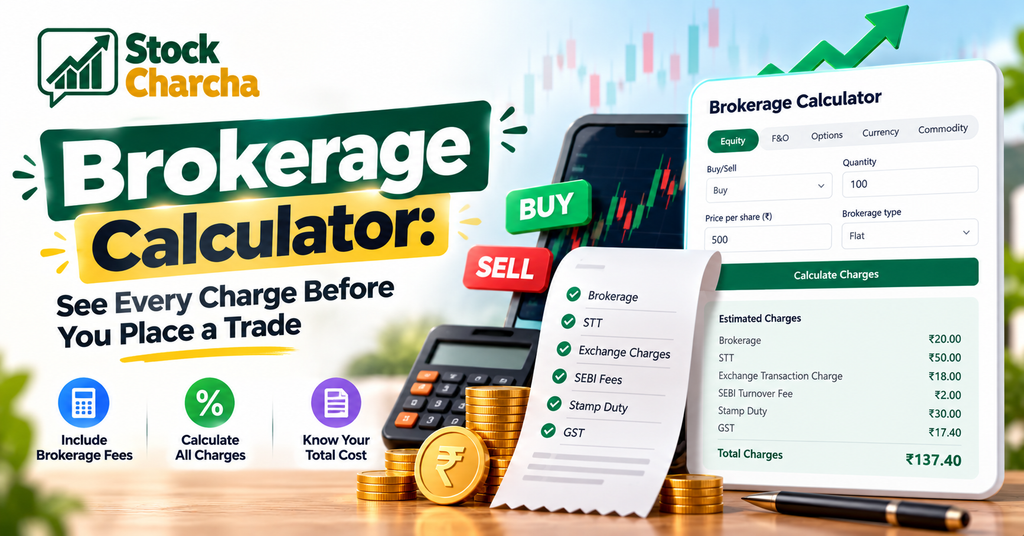
Say you buy 100 shares at ₹1,000 and sell them at ₹1,010 on the same day. On paper that is a ₹1,000 profit. After every charge at Zerodha’s published rates, a brokerage calculator shows you keep about ₹917.03, and that gap is the whole reason this tool exists.
How do you use this brokerage calculator?
- Pick the segment: equity delivery, equity intraday, futures or options.
- Choose NSE or BSE.
- Select a brokerage model. Zerodha published rates uses that broker’s charge list, or you can enter your own flat amount or percentage.
- Enter the buy price, sell price and quantity. For futures and options, quantity is lots multiplied by lot size.
- On delivery trades, check the DP charge field, which starts at Zerodha’s ₹15.34 per scrip sold.
- Press Calculate, then read the breakdown and the break-even price.
Stock Charcha built this brokerage calculator to show each charge on its own line, because a single total hides what is actually eating into your profit.
What charges does the brokerage calculator include?
Seven charges apply to most trades: brokerage, STT (securities transaction tax), exchange transaction charges, GST, SEBI charges, stamp duty and DP charges. STT is a government tax. Stamp duty is charged only on the buy side. This table shows the NSE rates the calculator uses, taken from Zerodha’s charge list.
| Charge | Delivery | Intraday | Futures | Options |
|---|---|---|---|---|
| Brokerage | ₹0 | ₹20 or 0.03% | ₹20 or 0.03% | ₹20 flat |
| STT | 0.1% buy and sell | 0.025% sell | 0.05% sell | 0.15% sell |
| Exchange (NSE) | 0.00307% | 0.00307% | 0.00183% | 0.03553% |
| Stamp duty | 0.015% buy | 0.003% buy | 0.002% buy | 0.003% buy |
Brokerage is whichever of ₹20 or 0.03% is lower, per executed order. GST is 18% of brokerage plus SEBI and exchange charges, and SEBI charges are ₹10 per crore. DP charges apply when you sell delivery shares. Rates change, so verify them on the Zerodha charges page as of today.
What does a worked example look like?
Here is the opening trade again: 100 shares bought at ₹1,000 and sold at ₹1,010, intraday on NSE, at Zerodha’s rates. These figures are illustrative.
| Item | Amount |
|---|---|
| Brokerage (₹20 each side) | ₹40.00 |
| STT | ₹25.25 |
| Exchange charges | ₹6.17 |
| GST | ₹8.35 |
| SEBI charges | ₹0.20 |
| Stamp duty | ₹3.00 |
| Total charges | ₹82.97 |
| Net profit | ₹917.03 |
The break-even is ₹0.83 per share. That is the price move you need just to cover every charge, so the stock must rise about that much before you earn a rupee.
Why do charges hurt small trades more?
Charges do not scale evenly with trade size. The table below uses the same 1% price move, ₹1,000 to ₹1,010, intraday at Zerodha’s rates, across three trade sizes.
| Buy value | Gross profit | Total charges | Charges as % of profit |
|---|---|---|---|
| ₹10,000 | ₹100 | ₹10.69 | 10.7% |
| ₹1,00,000 | ₹1,000 | ₹82.97 | 8.3% |
| ₹10,00,000 | ₹10,000 | ₹404.89 | 4.0% |
The smaller the trade, the bigger the share of your profit that disappears. Delivery works differently: even at zero brokerage, a ₹1,00,000 trade sold at ₹1,01,000 costs about ₹238.86 in charges, and ₹201.00 of that is STT.
What does this brokerage calculator leave out?
It does not include demat AMC, the ₹50 call and trade fee, delayed payment interest, MTF interest or pledge charges. It also cannot read your broker’s own plan unless you enter it in the flat or percentage option. Contract notes round each figure, so expect small differences of a few paise.
Exchange transaction charges are revised from time to time, so check the NSE website as of today. Income tax on your profits is a separate matter. Trading in the securities market carries risk, and charges apply whether you win or lose.
Where should you go after using the brokerage calculator?
If the numbers made you rethink your broker, read how to choose a broker in India, or browse our stock broker hub. New to day trading? Start with how to do intraday trading.
Still need an account for delivery trades? Our guide to opening a demat account walks through it. Run the brokerage calculator before every trade until checking costs becomes a habit.
Founder of Stock Charcha. Stock market enthusiast, actively investing since November 2022. About the author
Educational content only. Charges shown are estimates, not a quote from any broker, and this is not personalised financial advice. Confirm final figures on your contract note and speak to a SEBI-registered adviser before you trade. Read our disclaimer.
Frequently asked questions
Why do I pay charges even when brokerage is zero?
Brokerage is only one part of the cost. STT, exchange charges, GST, stamp duty and DP charges are levied by the government, exchanges and depositories, so they apply even when your broker charges nothing for delivery trades.
Can I use this brokerage calculator for other brokers?
Yes. Choose the flat or percentage model and enter your broker’s rate. STT, stamp duty and SEBI charges are the same for everyone, so only brokerage and the DP charge change. Check your broker’s charge list for the exact figures.
Does the calculator work for currency or commodity trades?
No. It covers equity delivery, equity intraday, futures and options only. Currency and commodity contracts have their own STT or CTT, exchange charges and stamp duty rates, so results for them would be wrong.
Are brokerage and STT tax deductible?
If you report trading as business income, brokerage, STT and other trading costs can generally be claimed as business expenses. The treatment depends on how your income is classified, so confirm it with a chartered accountant.
How accurate is the brokerage calculator?
It is an estimate built on published rates and standard formulas. Your contract note is the final word, since brokers round each charge and rates get revised. Treat the result as a planning figure before you place the trade.