
Enter the issue price, lot size, lots applied and lots allotted, then a sell price. This IPO profit calculator shows your listing day profit after charges and tax, and handles partial allotment.
IPO Profit Calculator
Works for full allotment, partial allotment or no allotment at all.
Blocked money that is not allotted earns no return and no loss; it is simply released back to you by your bank (ASBA).
Your result in detail
| Item | Value |
|---|
Educational estimate, not tax advice. Grey market premium is not used anywhere in this calculator.
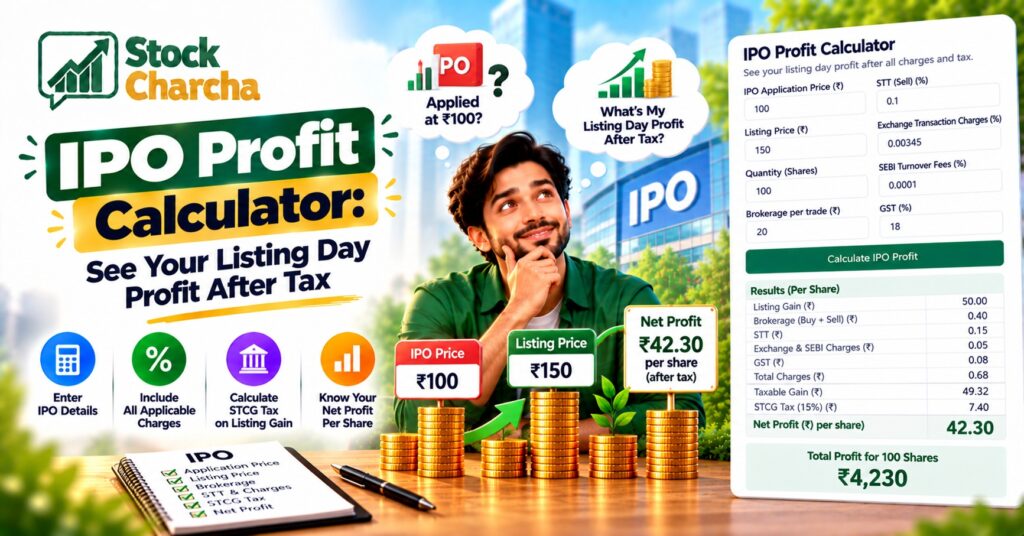
You apply for 10 lots of an IPO priced at ₹100, the stock lists at a 20% gain, and you expect to pocket ₹30,000. After charges and tax it is closer to ₹23,390, and that assumes every lot was allotted. An IPO profit calculator shows the real number, including what happens if it was not.
How do you use this IPO profit calculator in 3 steps?
- Enter the issue price, the lot size and the number of lots you applied for.
- Enter the lots actually allotted. If it is less than you applied for, the calculator works out your refund too.
- Enter the price you plan to sell at, on listing day or later, and read the profit after tax.
If you were not allotted any lots, set lots allotted to zero. Stock Charcha built this calculator to cover every outcome of an IPO application, not just the best case.
How does the IPO profit calculator handle partial allotment?
Under ASBA, your bank blocks the full application amount but only debits what is actually allotted. The rest is released back to you automatically, with no charge and no interest either way.
Refund = (Lots applied × Lot size × Issue price) − (Lots allotted × Lot size × Issue price)
So your real investment is only the allotted amount, and your real return should be measured against that figure, not the amount that was blocked.
What does a worked example look like?
Take an IPO at ₹100 a share, a lot size of 150, 10 lots applied for and fully allotted, sold at ₹120 on listing day. These figures are illustrative.
| Item | Value |
|---|---|
| Shares allotted | 1,500 |
| Amount invested | ₹1,50,000 |
| Gross profit (20% listing gain) | ₹30,000 |
| Charges | ₹380.18 |
| Net profit before tax | ₹29,620 |
| Estimated tax | ₹6,230 |
| Profit after tax | ₹23,390 |
Tax and charges together take about 22% of the gross profit. The listing gain looked like 20%, but the return after tax works out closer to 15.6% on the money invested.
What happens with partial allotment?
Take the same IPO, but only 3 of your 10 lots are allotted. This is common in oversubscribed issues decided by lottery.
| Item | Value |
|---|---|
| Shares allotted | 450 of 1,500 applied for |
| Amount invested | ₹45,000 |
| Amount refunded | ₹1,05,000 |
| Profit after tax (at the same 20% gain) | ₹7,009 |
At Stock Charcha we keep lots applied and lots allotted as separate inputs, because they are rarely the same in a popular issue. Your profit shrinks with your allotment, but so does your risk, because the refunded money was never at risk in the stock. If nothing is allotted, the IPO profit calculator shows the full amount refunded, with no gain and no loss.
How much does the listing gain change your return?
Here is the same 1,500 shares at ₹100, sold at different listing gains.
| Listing gain | Net profit before tax | Estimated tax | Profit after tax |
|---|---|---|---|
| 5% | ₹7,143 | ₹1,550 | ₹5,593 |
| 10% | ₹14,635 | ₹3,110 | ₹11,526 |
| 20% | ₹29,620 | ₹6,230 | ₹23,390 |
| 30% | ₹44,604 | ₹9,349 | ₹35,255 |
| 50% | ₹74,573 | ₹15,589 | ₹58,984 |
A listing can also open below the issue price. Sell 1,500 shares at ₹85 instead of ₹120, and the IPO profit calculator shows a loss of about ₹22,826, with no tax due on it.
Why is grey market premium not part of this calculator?
Grey market premium, often shown as GMP, is an unofficial, unregulated indicator traded outside any exchange. It is not a reliable guide to the actual listing price, and it can swing sharply right up to listing day. This calculator uses only the sell price you enter, not any GMP figure.
What does this IPO profit calculator leave out?
It assumes you sell the full allotment at one price on one day, so it does not model selling in parts over several days. It also does not cover anchor investor allotments, employee or shareholder quotas, or the lock-in periods that apply to some categories. For charges on a single trade, see our brokerage calculator.
This is an estimate, not tax or investment advice, and an IPO carries the same market risk as any listed stock. Investments in the securities market are subject to market risks. Read the red herring prospectus and all offer documents carefully before applying.
Where should you go after using the IPO profit calculator?
To work out tax across several sales in the year, use the share capital gains tax calculator. For one trade with full charges, try the stock profit and loss calculator.
New to applying for IPOs? Read about opening a demat account and choosing a broker in India. The IPO section of the Charcha Knowledge Hub has more. Run the IPO profit calculator again once the allotment is out and the real numbers are known. Stock Charcha uses the same tax and charge rates here as on its other trading calculators, so the figures stay consistent across pages.
Related calculators
- Stock profit and loss calculator
- Share capital gains tax calculator
- Brokerage calculator
- Stock average calculator
Last updated: 3 October 2026. Tax and charge rates checked on 2 and 3 October 2026 (Zerodha charge list; Income Tax Act section 111A). Review after each Union Budget.
Founder of Stock Charcha. Stock market enthusiast, actively investing since November 2022. About the author
Educational content only. This page is not personalised financial or tax advice, and nothing here is a recommendation to apply for, buy or sell any IPO or stock. GMP figures, where mentioned on this site, are unofficial and unreliable. Please do your own research or speak to a SEBI-registered adviser before applying, and read our disclaimer.
Frequently asked questions
Is the IPO profit calculator result guaranteed?
No. It uses the sell price you enter, and the actual listing price depends on market demand on listing day. Treat the figures as a planning estimate, and compare a gain scenario with a loss scenario before you apply.
What happens to my money if I am not allotted any shares?
Under ASBA, your bank only blocks the amount while the IPO is open and never actually debits it unless you are allotted shares. The full blocked amount is released back to your account automatically, with no charge.
Is IPO listing day profit taxed as short-term or long-term?
Almost always short-term, since selling on listing day means the shares were held for a day or two, far under the 12-month threshold. The calculator applies the 20% short-term rate plus cess on any listing day sale.
Should I trust the grey market premium before applying?
Treat it as one unofficial signal, not a forecast. GMP trades outside any exchange, is unregulated, and can change sharply before listing. This calculator does not use GMP anywhere, only the sell price you choose to test.
Does the calculator include DP charges and other selling costs?
Yes, for the sell side: STT, exchange charges, stamp duty, SEBI charges, GST and the DP charge are all included. It assumes no brokerage is charged on the sale, so adjust the sell price if your broker charges one.