
Add each stock sale as short-term or long-term, enter the gain or loss, and this share capital gains tax calculator totals your STCG and LTCG tax for the year, with the ₹1.25 lakh exemption applied correctly.
Share Capital Gains Tax Calculator
For listed equity shares sold during one financial year. Add every sale, not just one.
Rates: STCG 20%, LTCG 12.5% above a ₹1.25 lakh yearly exemption, plus 4% cess. Checked 3 October 2026 (Income Tax Act sections 111A and 112A).
Your result in detail
| Item | Value |
|---|
Educational estimate, not tax advice. Confirm your tax with a chartered accountant.
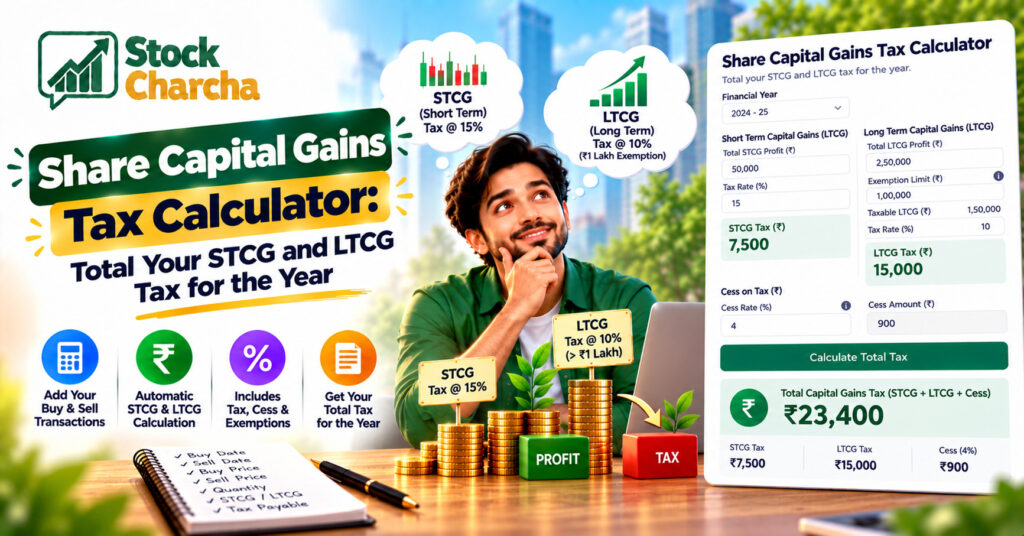
You sold three stocks this year: one short-term gain, one long-term gain, one long-term loss. Add them up separately in your head and you will probably get the tax wrong. A share capital gains tax calculator keeps STCG and LTCG apart, the way the tax rules do, and applies the exemption only where it is allowed. Stock Charcha built this version to handle several sales at once, not just one.
How do you use this share capital gains tax calculator in 3 steps?
- For every stock you sold this year, add a row: pick short-term or long-term, then enter the gain as a positive number or the loss as a negative number.
- If you have already used some of your ₹1.25 lakh LTCG exemption on other sales, such as equity mutual funds, enter that amount.
- Press Calculate and read the STCG tax, the LTCG tax and the total, plus the detailed breakdown.
Add a short label to each row if it helps you match it to your contract notes later. The share capital gains tax calculator keeps every entry inside your browser, so nothing is stored or sent.
How does the share capital gains tax calculator split STCG and LTCG?
Short-term gains, from shares held 12 months or less, and long-term gains, from shares held longer, are taxed under separate rules and cannot be mixed.
STCG tax = Net short-term gains × 20% × (1 + 4% cess)
LTCG tax = (Net long-term gains − exemption available) × 12.5% × (1 + 4% cess)
The share capital gains tax calculator adds every short-term row into one net figure and every long-term row into another, then applies each formula once. These rates were checked on 3 October 2026 against the Income Tax Act, sections 111A and 112A, and can change with a Budget.
What does a worked example look like?
Take a short-term gain of ₹1,40,000, a long-term gain of ₹3,00,000 and a long-term loss of ₹40,000, with no exemption used elsewhere. These figures are illustrative.
| Item | Value |
|---|---|
| Net short-term result | ₹1,40,000 |
| STCG tax | ₹29,120 |
| Net long-term result | ₹2,60,000 |
| LTCG exemption available | ₹1,25,000 |
| LTCG taxable after exemption | ₹1,35,000 |
| LTCG tax | ₹17,550 |
| Total tax payable | ₹46,670 |
The ₹40,000 long-term loss reduced the taxable long-term gain before the exemption was applied, not after. That order matters, and the calculator gets it right automatically.
How does the ₹1.25 lakh exemption actually work?
The exemption applies once a year to your total long-term equity gains, not to each stock separately. If you already used some of it on equity mutual funds or other shares, enter that amount and the share capital gains tax calculator reduces what is left.
| Situation | LTCG tax |
|---|---|
| ₹1,00,000 LTCG, exemption untouched | ₹0 |
| ₹2,00,000 LTCG, exemption untouched | ₹9,750 |
| ₹2,00,000 LTCG, ₹1,25,000 exemption already used elsewhere | ₹26,000 |
The same ₹2,00,000 gain can cost nothing extra in tax or the full 12.5% plus cess, depending on what else you sold during the year. That is the detail a single-trade calculator cannot show.
Can a loss on one stock reduce the tax on another?
Within the same head, yes. A long-term loss offsets long-term gains, and a short-term loss offsets short-term gains, before the exemption is applied. A long-term loss cannot reduce short-term tax, and the reverse is also true.
If your short-term sales net out to a loss, as in a ₹1,00,000 gain against a ₹1,50,000 loss, the net is a ₹50,000 loss and the STCG tax is zero. Losses not used this year can generally be carried forward if you file on time, under rules this calculator does not cover.
What does this share capital gains tax calculator leave out?
It does not include surcharge, your other income, TDS, or grandfathering for shares bought before 1 February 2018. It also assumes you already have each sale’s exact gain or loss figure, so it does not compute gains from a buy and sell price itself. For that, and for brokerage and charges on one trade, use our stock profit and loss calculator.
It also does not handle unlisted shares, which follow different rates and periods, or set-off rules against non-equity gains. This is an estimate, not tax advice. Investments in the securities market are subject to market risks.
Where should you go after using the share capital gains tax calculator?
To work out the gain or loss on one trade, including brokerage, use the stock profit and loss calculator. If you bought the same stock in several lots, the stock average calculator helps you track the cost.
Measure your return with the CAGR calculator or the XIRR calculator for several purchase dates. The Taxes section of the Charcha Knowledge Hub has more on the basics. Keep your contract notes beside you while you fill in each row.
Related calculators
Last updated: 3 October 2026. Tax rates checked on 3 October 2026 (Income Tax Act sections 111A and 112A, as summarised by several tax sources). Review after each Union Budget.
Founder of Stock Charcha. Stock market enthusiast, actively investing since November 2022. About the author
Educational content only. This page is not personalised financial or tax advice, and nothing here is a recommendation to buy or sell any stock. Please do your own research or speak to a SEBI-registered adviser or a chartered accountant, and read our disclaimer.
Frequently asked questions
Do I enter each stock sale separately or one combined figure?
Enter each sale as its own row in the share capital gains tax calculator. It adds all short-term rows together and all long-term rows together, so you get one combined STCG tax and one combined LTCG tax for the year.
Can a long-term loss reduce my short-term capital gains tax?
No. Short-term and long-term gains are taxed separately, and losses can only offset gains within the same head. A long-term loss reduces long-term gains, and a short-term loss reduces short-term gains, not the other way round.
Does the ₹1.25 lakh exemption apply to each stock or for the whole year?
It applies once a year to your total long-term equity gains, across every stock and equity mutual fund you sold. If you used part of it elsewhere, enter that amount so the calculator applies only what is left.
Does this calculator include surcharge or my other income?
No. It adds the 4% cess but leaves out surcharge, which applies only at higher incomes, and it does not consider your salary or other income. Your actual tax liability depends on your full return.
Where do I find my gain or loss for each sale?
Your broker’s contract notes, trading statement or capital gains statement list the buy price, sell price and dates for each sale. Subtract buy from sell, including any charges you want to account for, and enter that as the gain or loss.