
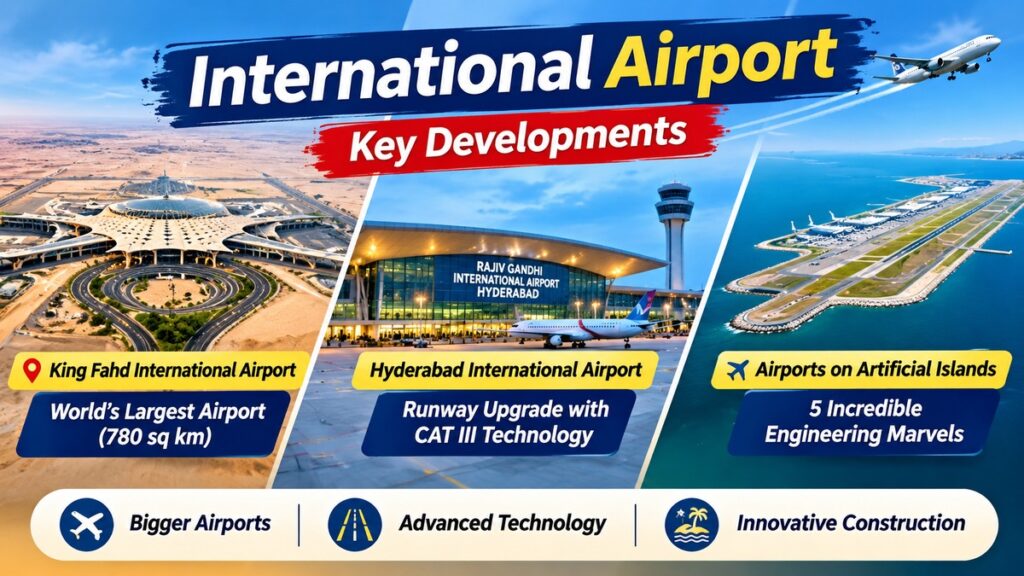
Airports are no longer just places where passengers board flights. They are becoming massive infrastructure hubs, engineering landmarks and important drivers of economic growth. The latest International Airport developments have caught attention in India, from Saudi Arabia’s enormous King Fahd International Airport to Hyderabad’s new CAT III runway capability. Meanwhile, airports built on artificial islands in Japan, China and Turkey demonstrate how engineering is overcoming geographical limitations. Here is a closer look at these fascinating developments.
Why Is the World’s Largest International Airport Making Headlines?
One of the biggest talking points in global aviation is King Fahd International Airport in Saudi Arabia. Located near Dammam, it holds the Guinness World Records title for the world’s largest airport by land area.
According to Guinness World Records, the airport covers approximately 780 square kilometres. That is an extraordinary footprint for an aviation facility and even larger than the land area of neighbouring Bahrain.
However, there is an important distinction between total airport land and the area used for daily passenger operations. Not all 780 square kilometres are occupied by terminals, runways and passenger facilities. A significant portion is reserved land and undeveloped desert.
The airport has two parallel runways, each measuring 4,000 metres, and infrastructure that includes aircraft stands and helicopter facilities.
The interesting part is that its record comes from land area, not passenger traffic. A smaller airport can handle more passengers while King Fahd retains its remarkable size record. This distinction explains why airport rankings should always be compared using the same measurement.
What Is New at Hyderabad International Airport?
India’s aviation infrastructure has also received attention following an important development at Rajiv Gandhi International Airport in Hyderabad.
On November 10, 2026, GMR Hyderabad International Airport Limited commissioned CAT III Airfield Ground Lighting capability for Runway 09R.
According to HMTV’s report on the Hyderabad Airport upgrade, the development upgrades the runway’s capability from CAT II to CAT III, strengthening operations during low-visibility conditions.
So, what does CAT III mean for passengers?
CAT III is an advanced instrument landing system category designed to support aircraft operations in very low visibility, subject to the required aircraft, crew and airport approvals. It is particularly useful during winter fog, when pilots may face difficulties seeing runway markings and lights.
The Hyderabad upgrade includes CAT III-compliant runway lighting, advanced monitoring systems and Stand Manoeuvring Guidance Lights. The airport has also implemented an indigenous PLC-SCADA-based solution to monitor and control lighting systems centrally.
The expected benefits include fewer weather-related diversions, improved operational reliability and potentially fewer delays during poor visibility. However, the technology does not eliminate every weather-related disruption.
For passengers travelling through Hyderabad, this is an important step towards more dependable airport operations.
How Are Airports Being Built on Artificial Islands?
One of the most fascinating developments in global aviation is the construction of an International Airport on artificial islands.
In densely populated coastal cities, finding enough land for long runways and passenger terminals can be difficult. Instead of expanding into crowded urban areas, engineers have developed a different solution: creating new land in the sea using rocks, sand and other construction materials.
A recent report by AndhraPravasi on five artificial-island airports highlights five remarkable examples.
Which Five Airports Are Built on Artificial Islands?
1. Macau International Airport, China
Opened in 1995, Macau International Airport uses reclaimed land in the Pearl River Estuary. Interestingly, its runway was built on reclaimed land, while the passenger terminal and supporting facilities are located on Taipa Island. This approach helped overcome the region’s land limitations.
2. Kansai International Airport, Japan
Located in Osaka Bay, Kansai International Airport opened in 1994 on an artificial island. Engineers faced a major challenge because of the soft seabed, which caused the island to sink over time. Special ground-improvement techniques were used to address the problem.
3. Ordu-Giresun Airport, Turkey
Opened in 2015, Ordu-Giresun Airport is a notable example of an airport constructed offshore in the Black Sea. Engineers used millions of tonnes of rock to create a stable foundation because the surrounding mountainous terrain offered limited space for construction.
4. Chubu Centrair International Airport, Japan
Located in Ise Bay, Chubu Centrair International Airport opened on February 17, 2005. Its artificial island was designed with consideration for surrounding water flows and the local marine environment. It serves Nagoya and the wider industrial region.
5. Hong Kong International Airport, China
Hong Kong International Airport opened in July 1998 on the reclaimed Chek Lap Kok site. Engineers removed hills and used the excavated material to reclaim land from the sea. The project became one of Hong Kong’s major infrastructure developments.
These five airports show how countries are using engineering to overcome geographical limitations and expand international connectivity.
How Do International Airports Support Economic Growth?
A modern International Airport contributes far more to an economy than passenger transportation alone.
Airports support tourism, international trade, cargo movement, employment and business travel. They also create demand for hotels, logistics companies, restaurants, retail businesses and transport services.
For India, improvements at airports such as Hyderabad are particularly important as businesses increasingly depend on reliable domestic and international connectivity.
Better airport infrastructure can help reduce operational disruptions, improve cargo movement and make destinations more accessible to international visitors.
However, airport development also requires substantial capital investment. Construction, maintenance, safety systems and environmental management all involve long-term costs.
Artificial-island airports present additional challenges, including land reclamation, coastal protection, soil settlement and environmental conservation.
The success of an airport should therefore not be measured by size alone. Passenger capacity, connectivity, operational reliability, financial sustainability and environmental impact are equally important.
What Should Travellers Watch in the Latest Airport Developments?
The latest International Airport developments highlight three important trends: bigger infrastructure, smarter runway technology and innovative construction.
King Fahd International Airport demonstrates how enormous airport land reserves can support long-term infrastructure planning. Hyderabad’s CAT III upgrade highlights the importance of technology in maintaining flight operations during poor visibility.
Meanwhile, artificial-island airports demonstrate how engineers are finding solutions to land shortages and geographical challenges.
For travellers, the most meaningful improvements are often practical: better connectivity, safer operations and fewer avoidable disruptions.
For India’s aviation sector, continued investment in airport infrastructure will remain important as passenger demand, international trade and tourism evolve.
The future of aviation is not simply about building bigger airports. It is about building smarter, safer and more sustainable connections between the world’s economies.
Frequently Asked Questions About International Airports
1. Which Is the World’s Largest International Airport?
King Fahd International Airport in Dammam, Saudi Arabia, is the world’s largest airport by land area. According to Guinness World Records, it covers approximately 780 square kilometres.
2. What Is the Latest Development at Hyderabad International Airport?
Hyderabad International Airport commissioned CAT III Airfield Ground Lighting capability on Runway 09R on November 10, 2026. The upgrade is expected to improve flight operations during low-visibility conditions, particularly during winter fog.
3. Which Airports Are Built on Artificial Islands?
Some notable examples include Kansai International Airport and Chubu Centrair International Airport in Japan, Hong Kong International Airport, Macau International Airport and Ordu-Giresun Airport in Turkey.
4. Why Are International Airports Built on Artificial Islands?
Artificial islands provide additional land where suitable construction space is limited. They help cities overcome geographical restrictions and accommodate runways, terminals and supporting infrastructure. However, these projects require extensive engineering and environmental planning.
5. Does CAT III Technology Reduce Flight Delays?
CAT III technology helps aircraft operate in lower-visibility conditions when the aircraft, crew and airport meet the necessary requirements. It can reduce some fog-related delays and diversions, but cannot prevent all weather-related disruptions.
Disclaimer: This article is intended for general informational and educational purposes. Airport infrastructure, technology and operational details may change. Readers should refer to official airport and aviation authority announcements for the latest information.