Introduction – From Middle-Class Dreams to Stock Market Discipline

Jab main peeche mudke dekhta hoon, toh meri stock market journey kisi fancy suit ya finance degree se start nahi hui. Yeh shuru hui ek chhote se town se… ek football match se… aur ₹3000 ke prize se.
Wahi tha mera pehla taste “earning through skill” ka us time mujhe share ya mutual fund ka matlab bhi nahi pata tha.
Jaise zyaadatar middle-class Indian families me hota h, main bhi bachpan se do cheezein sunte aaya:
- “Padhai karo, acchi naukri milegi”
- “Stock market se door raho risky he”
Lambe time tak main in dono baaton ko sach maanta raha… lekin zindagi ke apne plans hote he.
Mainne chhoti dukaano me kaam kiya, accounting firms me experience liya, aur online ventures bhi try kiye kuch chal gaye, kuch flop ho gaye (jaise mera Amazon KDP account jo ek raat me suspend ho gaya).
Maine US market me Tesla shares se apna profit double hote dekha, aur forex trading me panic sell karke loss bhi khaya.
Har ek win, har ek galti ne mujhe woh sikha diya jo koi textbook nahi sikha sakti.
Yeh guide Stock Market for Beginners in India (2025) mera tareeka he aapke saath woh lessons share karne ka simple, beginner-friendly language me taaki aap unhi galtiyon me na fasein jin me mai fas chuka hu, aur apni investing journey confidence ke saath start kar saken.
📌 Note: Main SEBI-registered advisor nahi hoon. Jo bhi aap yahan padhoge, woh mera personal experience, market research, aur credible Indian finance sources se seekha hua he. Yeh financial advice nahi he bas ek honest roadmap he beginners ke liye jo Indian stock market ko samajhna chahte he.
What Is the Stock Market in India? 🏦

Simple shabdon me, stock market ek aisi jagah he jahan companies public ko apna ek chhota ownership hissa dene ka mauka deti he. Isse share kehte he.
India me do main stock exchanges he:
- NSE (National Stock Exchange)
- BSE (Bombay Stock Exchange)
Jab aap ek share kharidte ho, aap sirf ek kagaz ka tukda nahi le rahe hote.
Aap us company ke tiny part-owner ban jaate ho.
Agar company grow karti he, toh aapki ownership ka value bhi badh sakta he.
📌 If you’re just starting and want a complete beginner-friendly explanation, check this: What Is the Stock Market? A Simple Guide for Indian Beginners.
How the Indian Stock Market Works ⚙️
Indian stock market ko SEBI (Securities and Exchange Board of India) regulate karta he.
Iska main kaam fairness maintain karna aur investors ko protect karna he.
Simple steps me samajhiye:
- Companies paisa raise karti he ek IPO (Initial Public Offering) ke through. (Curious? Read: How the Indian Stock Market Works)
- Investors shares ko buy aur sell karte he brokers ke through.
- Share prices demand, supply, company performance, aur market news ke hisaab se upar–niche hote he.
⏰ Trading Hours: 9:15 AM – 3:30 PM (Mon–Fri), pre-market session 9:00 AM se shuru hota he.
💡 Fun fact: Mujhe apna pehla live market experience abhi tak yaad he. Sirf kuch minute me stock price upar bhi gaya aur niche bhi. Tab samajh aaya ki patience stock market me knowledge jitna hi important he.
Stock Market Terms Every Beginner in India Should Know 📚
Jab maine start kiya tha, “bull” aur “bear” jaise words ne mujhe confuse kar diya tha.
Thoda time laga, lekin samajh aaya ki stock market terms samajhna beginners ke liye game changer he.
Kuch examples:
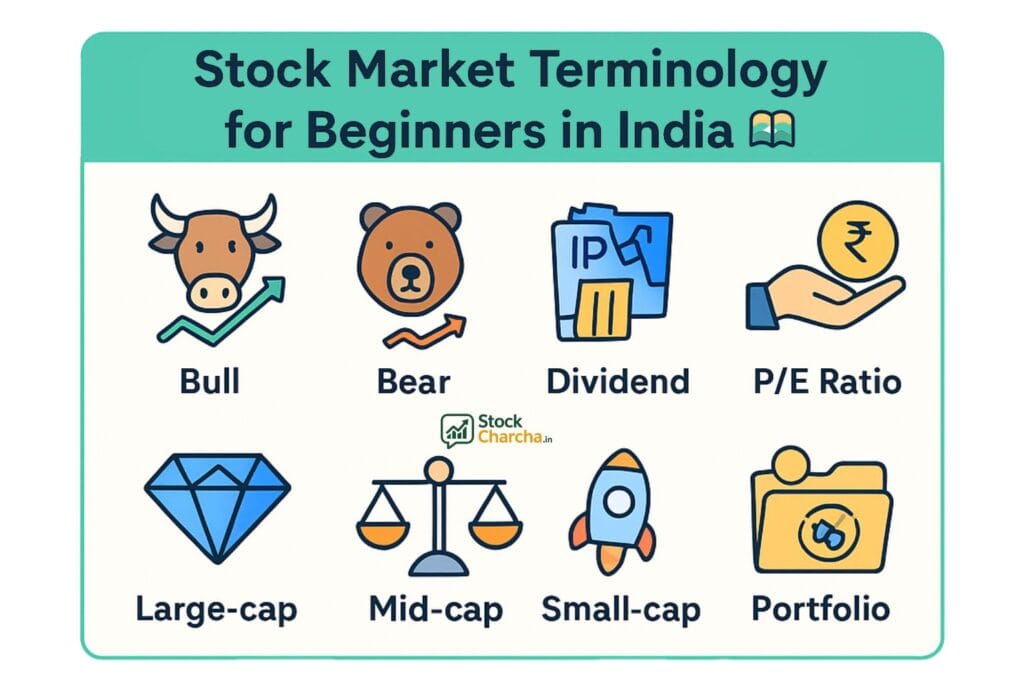
- Bull Market 🐂 – Jab prices rise kar rahe ho
- Bear Market 🐻 – Jab prices fall kar rahe ho
- Dividend 💰 – Company ke profit ka hissa jo shareholders ko diya jata he
- P/E Ratio 📊 – Ek popular tarika dekhne ka ki stock mehenga he ya sasta
Agar yeh terms aapke liye naye he, toh aapko yeh detailed guide pasand aayegi: Top 10 Stock Market Terms Every Indian Beginner Should Know.
💬 Key Takeaway: Stock market basics seekhna bilkul waise hi he jaise book padhne se pehle ABC seekhna.
Agar yeh foundation strong nahi hoga, toh market news aur charts hamesha Greek–Latin lagega.
Isliye start slow, basics samjho, aur phir confidently aage badho.
Accounts & Tools You Need to Start Investing in the Indian Stock Market 📲💼
Jab maine decide kiya ki stock market me entry leni he, mujhe laga bas paisa aur thoda knowledge chahiye.
Lekin jaldi samajh aa gaya sahi accounts aur tools ke bina investing bilkul waise hi he jaise cricket khelna bina bat ke 🏏.
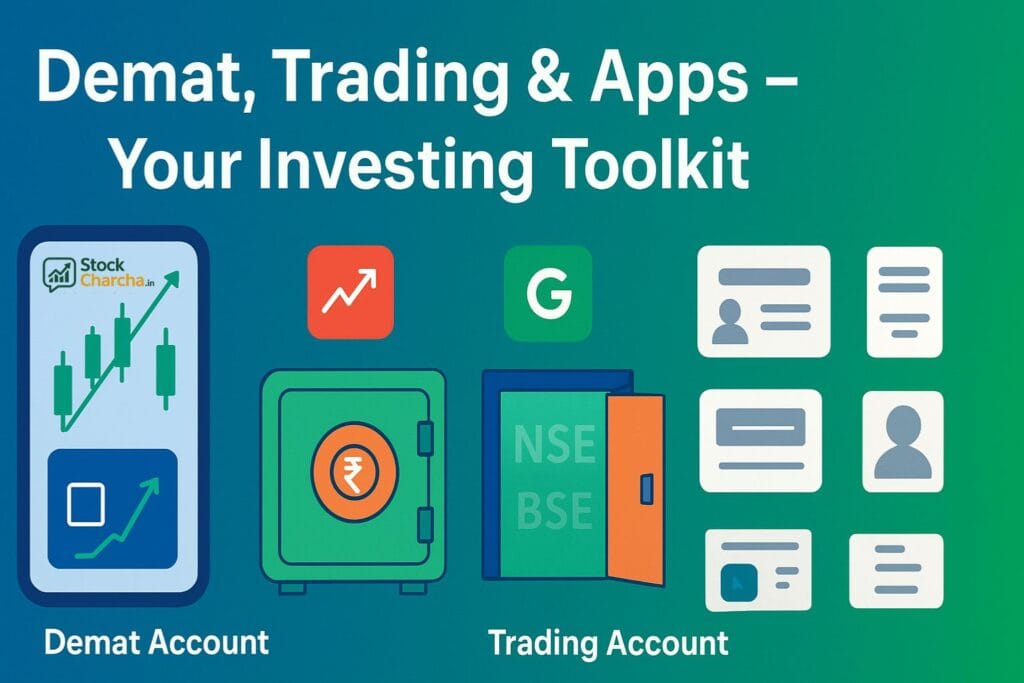
India me shares buy–sell karne ke liye Demat account aur trading account dono zaroori hote he.
Chaliye simple shabdon me samajhte he.
Demat Account in India – Your Digital Locker for Shares 🗄️
Demat account ek digital locker hota he jahan aapke shares electronically store hote he.
Bilkul waise jaise bank account me aapka paisa store hota he.
Yahan koi paper certificates ka jhanjhat nahi, aur kho jane ka tension bhi khatam.
Kyun zaroori he?
- Safe & secure storage of investments
- Easy transfer of shares
- Mandatory for all stock market transactions in India
📌 If you don’t know how to choose one, check this guide: Demat vs Trading Account: What Every Indian Investor Must Know.
Trading Account – Your Gateway to the Market 🚪📈
Demat account sirf shares ko store karta he.
Trading account aapko unhe buy–sell karne ka access deta he stock exchange (NSE ya BSE) ke through.
Soch ke dekho:
- Demat account = Locker
- Trading account = Shop jahan se aap shares kharid–bech sakte ho
💡 Pro tip from my experience: Broker hamesha aisa choose karo jiska brokerage low ho aur app interface tumhe pasand aaye.
Best Stock Market Apps in India for Beginners 📱⭐
Aaj kal sab kuch phone par he.
Trading, tracking, research sab mobile app se ho jata he.
Kuch popular beginner-friendly apps:
- Zerodha Kite
- Groww
- Upstox
- Angel One
📌 Detailed review yahan he: Top 5 Stock Market Apps for Indian Investors – Reviewed & Compared.
Documents Required to Open a Demat & Trading Account in India 📑
Accounts open karna aaj kal super simple he mostly online.
Usually aapko yeh chahiye hota he:
- PAN Card 🆔
- Aadhaar Card
- Bank account details
- Passport-size photograph
💬 Key Takeaway: Demat aur trading account ke bina aap stock market me pehla step bhi nahi le sakte.
Ek reliable broker choose karo, achha app download karo, documents ready rakho yeh hi aapka official ticket he investing start karne ka.
Stock Market Terminology for Beginners in India 📚💡
Jab maine investing shuru ki thi, stock market ke terms ek secret code language jaise lagte the.
Bull, bear, P/E ratio… kuch samajh hi nahi aata tha 😅.
Lekin time ke saath samajh aaya ki in basic terms ko samajhna market news, analysis aur investing decisions ko 10x easier bana deta he.
Chalo aapke liye simple me breakdown karte he.
Top 10 Stock Market Terms Every Indian Beginner Should Know 📝
Yeh seekh loge toh market news padhte time confusion khatam ho jayega.
- Bull Market 🐂 – Jab share prices upar ja rahe ho aur market sentiment positive ho.
- Bear Market 🐻 – Jab prices gir rahe ho aur investors me fear high ho.
- IPO (Initial Public Offering) 📢 – Jab company pehli baar apne shares public ko offer karti he.
- Dividend 💰 – Company ke profit ka ek hissa jo shareholders ke saath share kiya jata he.
- P/E Ratio (Price-to-Earnings) 📊 – Dekhne ka ek popular tarika ki stock mehenga he ya undervalued.
- Market Cap (Capitalization) 💼 – Company ke saare shares ka total market value.
- Liquidity 💧 – Asset ko kitni jaldi cash me convert kiya ja sakta he.
- Stop Loss 🛑 – Ek order jo automatically stock ko bech deta he agar price ek set limit se niche aa jaye.
- Portfolio 📂 – Aapke different investments ka collection.
- Index 📈 – Selected stocks ka group jo market performance represent karta he.
📌 Full detailed explanations yahan he: Top 10 Stock Market Terms Every Indian Beginner Should Know.
Types of Stocks in India – Large, Mid, and Small-Cap 🏦
India me companies ko market capitalization ke basis par teen categories me divide kiya jata he:
- Large-cap 💎 – Badi aur stable companies (lower risk)
- Mid-cap ⚖️ – Risk aur return ka balanced combination
- Small-cap 🚀 – High risk, lekin high return ka potential bhi
Inhe samajhne se aap apne risk tolerance ke hisaab se investment choose kar paoge.
📌 Full breakdown yahan milega: Types of Stocks in India Explained: Large-Cap, Mid-Cap & Small-Cap Made Simple.
Market Indices in India – Your Market Scoreboard 📊
Index ko aise samjho jaise ek scoreboard jo batata he ki market overall kaisa perform kar raha he.
- Sensex – BSE par listed top 30 companies
- Nifty 50 – NSE par listed top 50 companies
- Nifty 500 – Broader index of 500 companies
📌 Learn more here: How the Indian Stock Market Works.
💬 Key Takeaway: Stock market terms seekhna waise hi he jaise cricket ke rules seekhna before playing.
Bina rules samjhe match jeetne ki umeed mat rakho 🏏.
Different Ways to Invest in the Indian Stock Market 💰📈
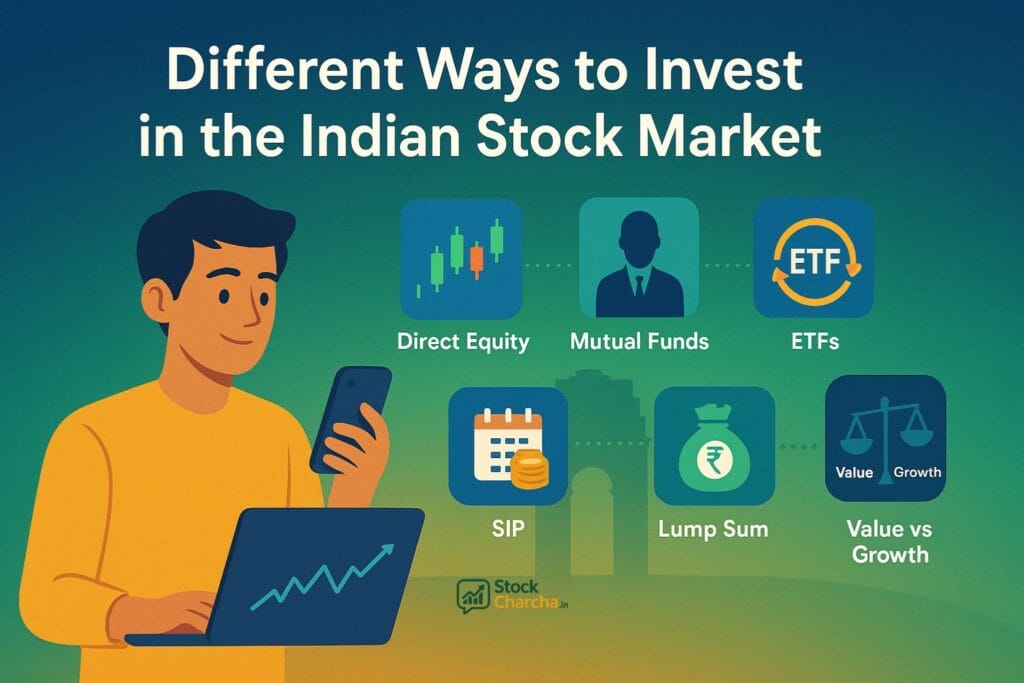
Jab maine apna Demat account open kiya tha, mujhe laga investing ka matlab sirf kuch shares kharid ke unke grow hone ka wait karna hota he.
Lekin thoda explore kiya toh pata chala Indian stock market me invest karne ke multiple tareeke hote he.
Har ek ka apna pros, cons, aur beginners ke liye suitability hoti he. Chalo simple me samajhte he.
Direct Equity – Owning Shares of Companies 🏢
Direct equity ka matlab hota he ki aap stock exchange (NSE/BSE) se kisi company ke shares kharidte ho.
Aur us moment se aap us company ke part-owner ban jaate ho.
Pros: High potential returns, dividend income, voting rights.
Cons: Proper research ki zarurat, higher risk, aur price fluctuations ka stress.
📌 If you’re comparing stocks and mutual funds, read: Mutual Funds vs Direct Stocks: Which Investment Option Is Best for You in India?.
Mutual Funds – Let Professionals Manage Your Money 📊
Mutual funds me kai investors ka paisa pool karke ek basket me invest kiya jata he stocks, bonds, ya other assets me.
Aapke liye ek fund manager buying–selling handle karta he.
Pros: Diversification, expert management, beginner-friendly.
Cons: Management fees, individual investments par kam control.
Exchange-Traded Funds (ETFs) – The Best of Both Worlds 🔄
ETFs mutual funds ki tarah hote he, lekin trade stock exchange par shares ki tarah hote he.
Pros: Lower cost, easy to buy/sell, usually kisi index (jaise Nifty 50) ko track karte he.
Cons: Returns index ke performance par depend karte he; actively managed nahi hote.
SIP vs Lump Sum Investing in India 🗓️💵
Beginners ka ek common question hota he fixed amount har month invest karun ya ek saath bada amount lagaun?
- SIP (Systematic Investment Plan): Har month ek fixed amount mutual fund me invest karna. Best for beginners jo slowly aur steadily invest karna chahte he.
- Lump Sum: Ek baar me bada amount invest karna. Best jab aapke paas already funds ready ho aur market conditions favourable lag rahi ho.
📌 Complete guide here: SIP vs Lump Sum: Which Investment Method Is Best for You?.
Value Investing vs Growth Investing 📈📉
- Value Investing: Undervalued companies kharid ke long-term hold karna.
- Growth Investing: Aisi companies buy karna jinke average se faster grow karne ki expectation ho.
💬 Key Takeaway: Investing me koi “one-size-fits-all” formula nahi hota. Best approach aapke goals, time horizon, aur risk appetite par depend karta he. Beginners ke liye, mutual funds ya ETFs se start karna generally sabse comfortable learning path hota he.
How to Start Investing Step-by-Step in the Indian Stock Market

Jab maine first time decide kiya ki invest karna he, mujhe lagta tha account open karo, shares buy karo, aur profit aa jayega 😅. Reality me pata chala ki successful investing sirf shares kharidne ka game nahi he. Yeh zyada planning aur discipline ka khel he.
Yeh he mera step-by-step stock market guide for beginners in India taaki aap clarity aur confidence ke saath start kar sako.
Step 1 – Set Your Financial Goals 🎯
Pehla rupee market me lagane se pehle yeh poochho:
- Kyun invest kar raha ho? (Wealth creation, retirement, education, etc.)
- Kitne time tak paisa invested rakh sakte ho?
💡 Beginner tip: Short-term needs (phone kharidna, trip pe jaana) ke liye stocks use mat karo.
Short-term me market volatile hota he.
Step 2 – Build an Emergency Fund 💼
Meri ek badi galti yeh thi ki maine backup fund ke bina invest karna shuru kiya. Jab emergency aayi, toh shares loss me bechne pade.
Isliye suggest karta hoon ki pehle 6 months ka expense savings account ya liquid fund me rakho. Uske baad hi stocks me invest karo.
Step 3 – Open Your Demat & Trading Account 📂
In accounts ke bina India me shares buy/sell nahi kar sakte.
- Demat account shares ko electronically store karta he.
- Trading account NSE/BSE par buy–sell karne ka access deta he.
📌 Complete guide: Demat vs Trading Account: What Every Indian Investor Must Know.
Step 4 – Choose Your First Investment 📊
Beginners ke liye, direct shares se start karna thoda tough hota he. Isliye mutual funds ya ETFs se shuru karo bilkul waise jaise swimming life jacket ke saath seekhna.
Comfortable hote hi slowly direct equity explore kar sakte ho.
Step 5 – Start Small, Stay Consistent 💵
Bada amount ek saath invest karne ki jaldi mat karo. Even ₹500–₹1000 per month SIPs me dalne se time ke saath kaafi difference aata he.
📌 Read more: How to Start Investing in Stocks in India with Just ₹500.
Step 6 – Track & Review Your Portfolio 🔍
Kam se kam har quarter me apne investments check karo. Goals change hote hi portfolio adjust karo. Aur haan prices har ghante mat check karo, warna stress hi badhega.
💬 Key Takeaway: Stock market me start karna sirf pehla step he. Magic tab hota he jab aap consistent rehte ho, emotional decisions avoid karte ho, aur apne goals par focus rakhte ho.
Risk Management & Building a Diversified Portfolio in India 🛡️📊
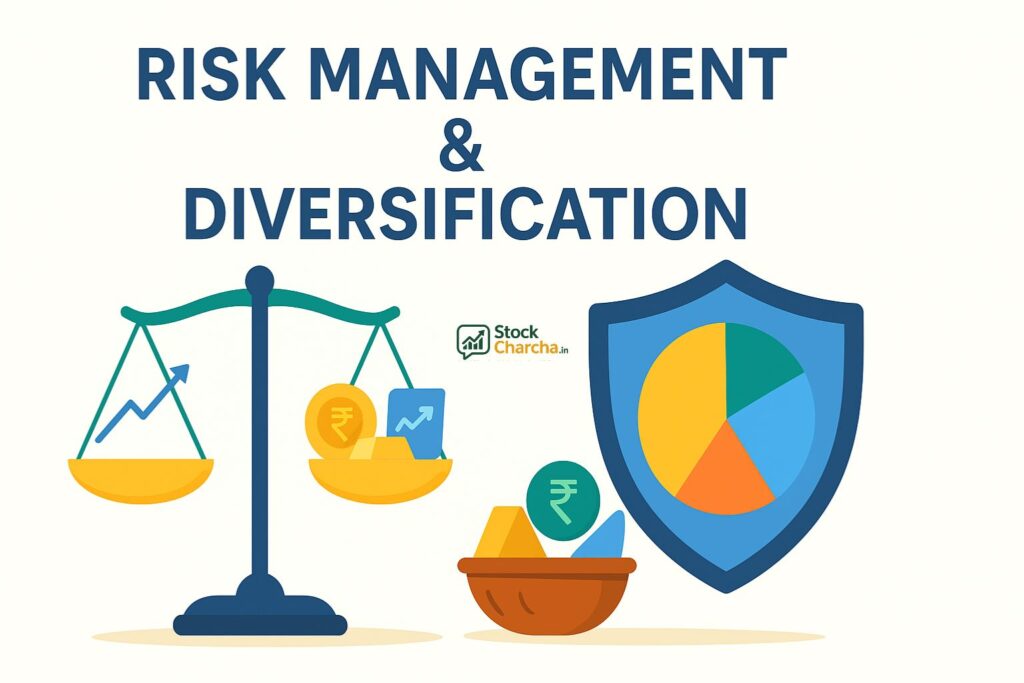
Mere early investing days ka ek tough lesson yeh tha profit banana easy lagta he, lekin paisa bacha ke rakhna usse bhi zyada important he.
Aur yahi kaam karta he risk management aur portfolio diversification.
Why Diversification Matters in the Indian Stock Market 🌱
Diversification ka matlab hota he apna paisa alag–alag stocks, sectors, aur asset classes me spread karna. Taaki agar ek investment ka performance kharab ho, toh doosre us loss ko balance kar sakein.
💡 Mera experience: Ek time maine sirf ek sector me heavy invest kiya tha. Aur jab woh sector crash hua, mera portfolio value patthar ki tarah neeche gir gaya. Tab samajh aaya never put all your eggs in one basket.
📌 Detailed guide: How to Build a Diversified Stock Portfolio in India: A Beginner’s Guide.
Asset Allocation for Indian Investors 📂
Asset allocation ka matlab he aapke investments ka mix stocks, mutual funds, ETFs, gold, aur dusre assets.
Ek beginner-friendly example:
- 50% Mutual Funds (Equity + Index funds)
- 30% ETFs (Jaise Nifty 50 ETF)
- 20% Direct Equity (Individual stocks)
Right mix aapke risk tolerance aur investment goals par depend karta he.
Risk Management in the Stock Market 🚦
Achhe investors sirf profits pe focus nahi karte wo apne capital ko protect karte he.
Simple tarike:
- Stop Loss 🛑 – Price ek certain level se niche jate hi stock automatic sell ho jaye.
- Limit Position Size – Ek stock me apne portfolio ka 10–15% se zyada invest na karein.
- Avoid Overtrading – Zyada buying–selling sirf costs badhata he aur risk bhi.
Balancing Risk & Reward in India’s Market ⚖️
Indian stock market me higher returns ke saath higher risk bhi aata he.
- Equity (Stocks) – High risk, high reward
- Debt (Bonds, Fixed Deposits) – Low risk, stable returns
- Gold – Safe-haven asset, specially uncertain times me
Inka sahi combination aapko ek balanced portfolio deta he jo steadily grow kare, bina zyada sleepless nights ke.
💬 Key Takeaway: Investing me survival hi success he. Portfolio diversification aur risk management jitni jaldi master kar loge, utni jaldi market ke emotional rollercoaster se bach paoge.
Common Mistakes Beginners in India Should Avoid 🚫📉
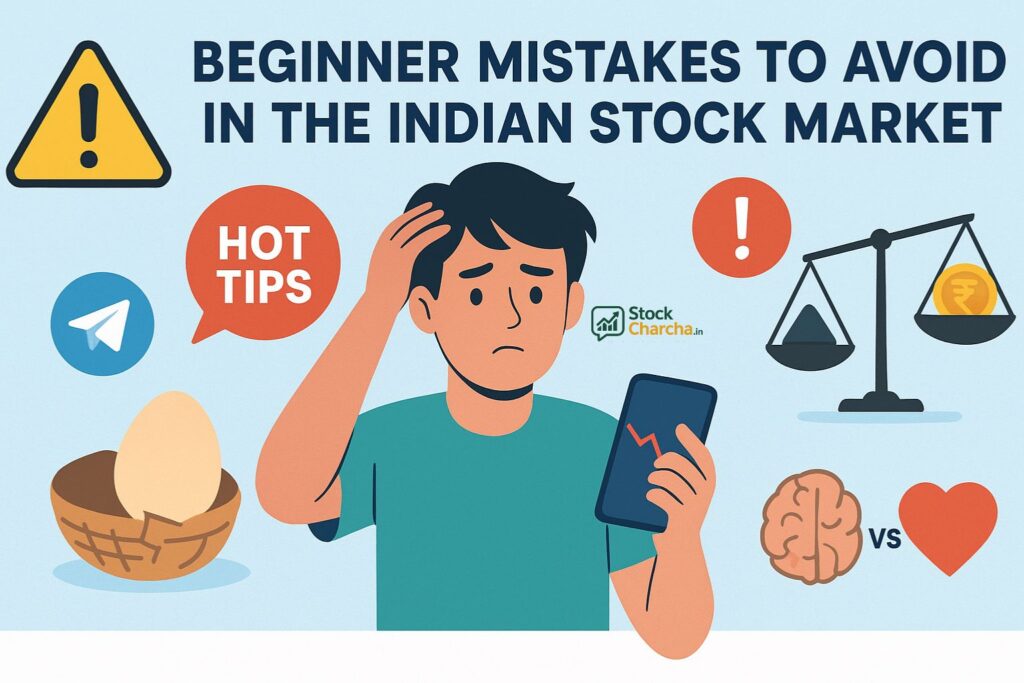
Jab maine investing start ki thi, maine bhi wohi galtiyan ki jo zyaadatar beginners karte he overconfidence, “hot tips” ke peeche bhaagna, aur overnight profits ki umeed rakhna.
Yeh beginner investing mistakes India me aapke mehnat se kamaye hue paise ko aap sochoge usse bhi jaldi wipe out kar sakti he. Chalo dekhte he sabse common mistakes (aur unse bachne ka tareeka).
1. Investing Without Learning the Basics 📚
Bahut beginners sirf kuch social media videos dekh ke market me jump kar jaate he. Sochte he kuch mahino me paisa double ho jayega.
Par stock market basics samjhe bina invest karna waise hi he jaise driving seekhe bina road pe nikal jaana.
📌 Brush up here: What Is the Stock Market? A Simple Guide for Indian Beginners.
2. Chasing Stock Tips on YouTube & Telegram 📲
Main bhi wahan raha hoon koi post dekhi “Buy XYZ stock now, yeh upar udne wala he!” aur turant invest kar diya. Reality me inme se zyada tips adhuri, galat, ya pump-and-dump scams ka hissa hoti he.
📌 Must-read: Are Stock Tips on YouTube & Telegram Safe? What Every Indian Investor Must Know.
3. Putting All Money in One Stock 🥚
Ek stock me saara paisa daalna matlab apne saare ande ek hi tokri me rakhna. Agar woh stock crash ho gaya, toh portfolio bhi crash ho jaata he.
Diversify karo alag-alag stocks, sectors, aur asset classes me invest karo.
📌 Learn how: How to Build a Diversified Stock Portfolio in India: A Beginner’s Guide.
4. Letting Emotions Drive Your Decisions 🧠❤️
Jab prices upar jaati he toh greed kaam karta he.
Jab girti he toh fear control le leta he.
Aur isi chakkar me log high pe kharidte he aur low pe bech dete he.
📌 Read more: Emotions vs Logic: How to Stay Disciplined While Investing in Indian Stocks.
5. Ignoring Risk Management 🚦
Beginners aksar sirf returns pe focus karte he, risk ignore kar dete he. Stop-loss orders use karna, aur position size limit rakhna, aapko bade losses se bacha sakta he.
📌 Guide: Risk Management & Building a Diversified Portfolio in India.
💬 Key Takeaway: Indian stock market me in common mistakes se bachna aapko saalon ki frustration se bacha sakta he. Pehle seekho, phir invest karo. Aur yaad rakho stock market me slow and steady hi race jeetata he 🐢📈.
How to Read and Understand Stock Market Data in India 📊🔍

Jab maine investing start ki thi, stock chart dekhna mere liye waise tha jaise bina doctor bane ECG report padhne ki koshish karna 😅. Lekin time ke saath samajh aaya ki stock market data samajhna koi rocket science nahi he bas sahi approach chahiye.
Aise hi maine dheere-dheere numbers, charts, aur reports ko samajhna seekha. Aap bhi step-by-step easily master kar sakte ho, bina overwhelm hue.
Understanding Stock Prices & Tickers 💹
Har stock jo NSE ya BSE par listed hota he, uska ek ticker symbol hota he (jaise TCS, RELIANCE, INFY). Uske saath aap kuch important cheezein dekhte ho:
- LTP (Last Traded Price): Latest price jis par stock trade hua.
- Change (%): Kal ke comparison me price kitna move hua.
- Volume: Ek din me total shares kitne trade hue.
📌 Beginner-friendly guide: What Is the P/E Ratio? How Indian Investors Can Use It to Evaluate Stocks.
Understanding Stock Charts for Beginners in India 📈
Stock chart batata he ki ek company ka share price time ke saath kaise move hua.
- Line Charts: Simple aur beginner-friendly.
- Candlestick Charts: Show karte he open, high, low, close prices ek period ke liye.
- Time Frames: 1 day, 1 month, 1 year, etc.
💡 Pro tip: Invest karne se pehle hamesha kam se kam 1-year chart check karo.
Short-term moves misleading ho sakte he.
Key Market Data to Watch 📋
Stock research karte time in points par dhyaan do:
- 52-Week High/Low: Last ek saal me highest aur lowest price.
- Market Cap: Company ka total market value.
- P/E Ratio: Quick valuation measure.
- Dividend Yield: Dividend se milne wala % return.
How to Read Financial Statements of Indian Companies 📑
Financial statements batate he ki company ki health kaisi he. Main teen reports hoti he:
- Balance Sheet: Assets & liabilities ka record.
- Income Statement: Profit & loss ka summary.
- Cash Flow Statement: Business me paise ka aana–jaana.
📌 Beginner’s breakdown: How to Read Financial Statements of Indian Companies (Beginner-Friendly Guide).
💬 Key Takeaway: Stock market data samajhna aapko ek confident investor bana dega.
Numbers jhooth nahi bolte yeh news headlines aur social media hype ke peeche ki real story dikhate he.
Long-Term vs Short-Term Investing in India ⏳📈
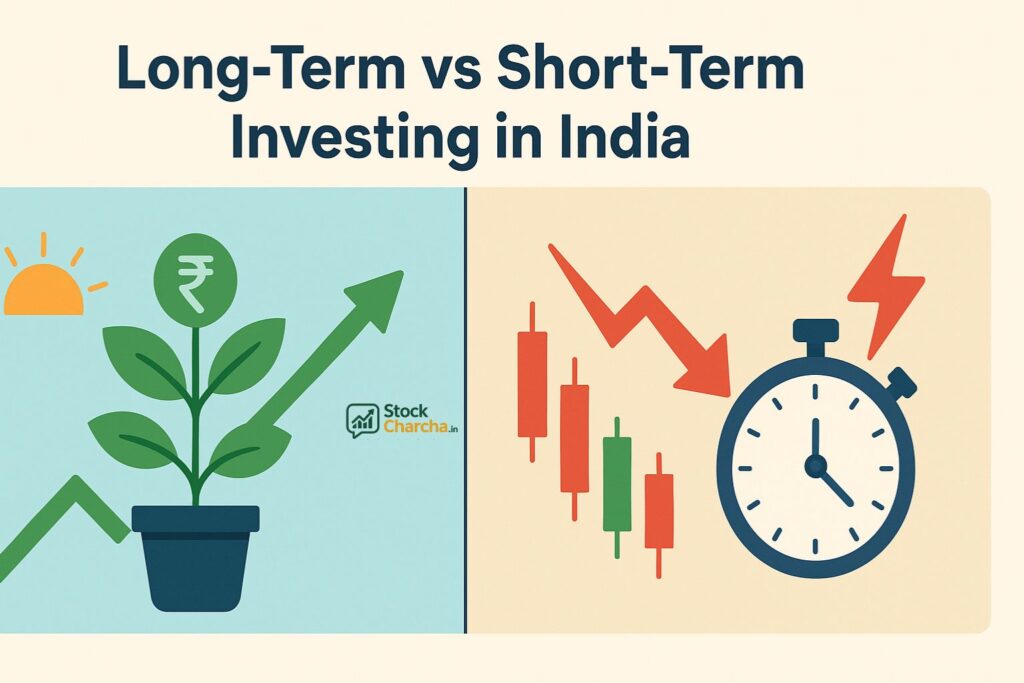
Har naya investor India me ek badi dilemma face karta he long term invest karun ya short term me quick profit kamaun? Dono approaches ka apna place he, lekin kaunsi strategy choose karni he, yeh aapke goals, risk appetite aur patience level par depend karta he.
Long-Term Investing in India 🌱
Long-term investing ka matlab hota he apne investments ko saalon tak hold karna generally 5+ years ya usse zyada.Isse aap apne money ko steadily grow hone ka time dete ho.
Pros:
- Compounding aapke favour me kaam karta he
- Daily price movements ka stress kam hota he
- LTCG (Long Term Capital Gains) tax benefits milte he
Cons:
- Patience aur discipline ki zarurat hoti he
- Agar jaldi paisa chahiye toh suitable nahi he
📌 Read more: Long-Term Investing in India: Why Time in the Market Beats Timing the Market.
💡 Mera experience: Mere best returns unhi stocks se aaye jo maine saalon tak hold kiye, bina daily market noise ke tension liye.
Short-Term Trading in India ⚡
Short-term trading me aap days, weeks, ya months ke andar buy–sell karke quick gains capture karte ho.
Pros:
- Quick profits ka chance
- Market volatility ka advantage le sakte ho
Cons:
- Higher risk aur stress
- Zyada time, research aur quick decision-making chahiye
- STCG (Short Term Capital Gains) me higher tax lagta he
📌 Beginners ke liye start small, pehle seekho, phir hi aggressively trade karo.
Time in the Market vs Timing the Market ⏰
Investing me ek famous kahawat he: “It’s not about timing the market, it’s about time in the market.”
Perfectly guess karna ki kab buy/sell karein, lagbhag impossible he professionals ke liye bhi. Lekin acche quality assets me long term invested rehna short-term ups and downs ko ride out karne me madad karta he.
💬 Key Takeaway: Agar aap beginner ho, toh long-term investing India me wealth build karne ka safest aur steady tareeka he. Experience aane ke baad, aur risk management samajhne ke baad, short-term opportunities explore kar sakte ho agar wo aapke style me fit baithti he.
Evaluating Stocks: Fundamental vs Technical Analysis in India 📊🔍
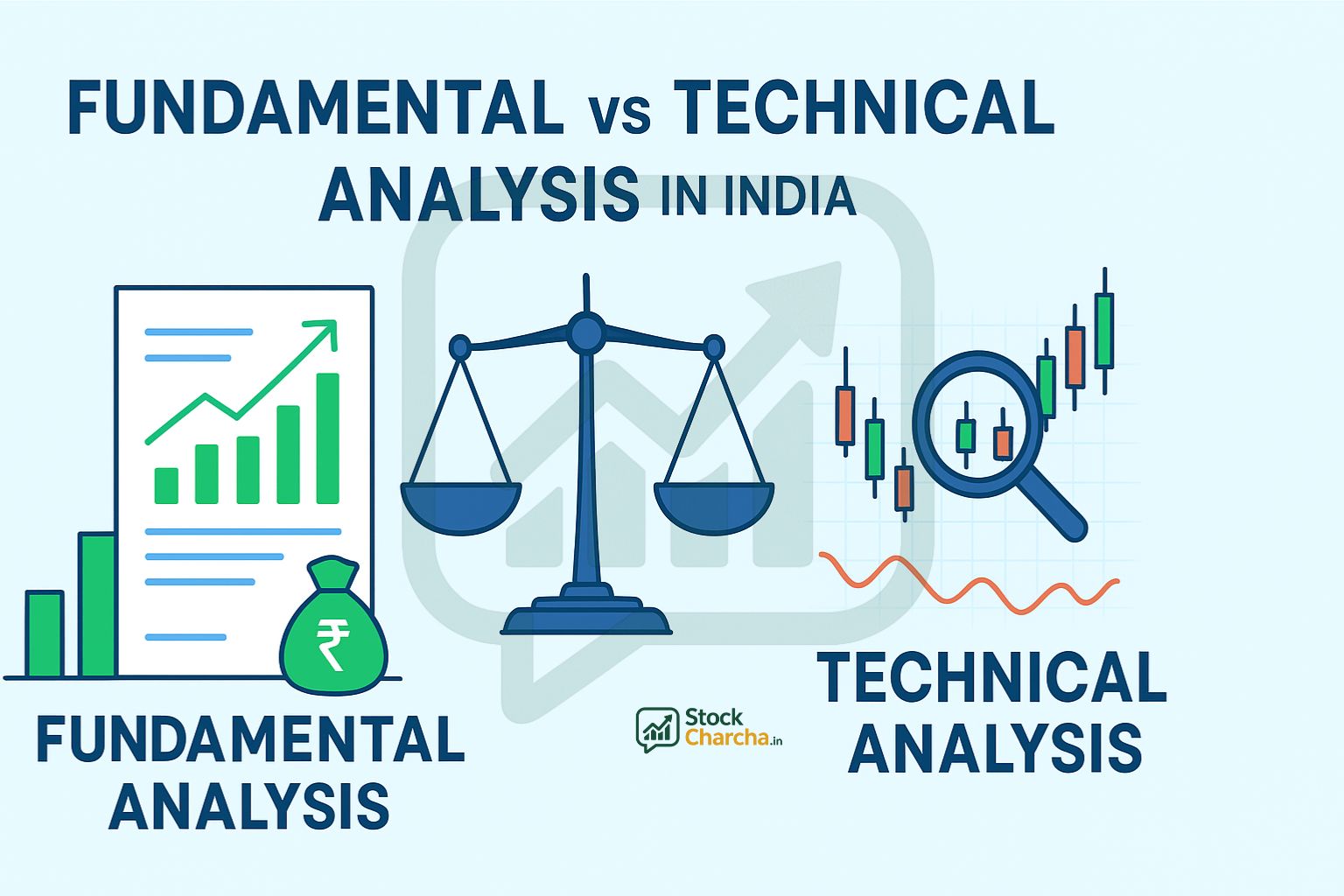
Jab maine apna pehla stock kharida tha, mujhe pata hi nahi tha ki company ke financials check karun ya sirf chart dekh ke trend guess kar lun 😅. Time ke saath samajh aaya ki India me stocks evaluate karne ke do main tareeke hote he Fundamental Analysis aur Technical Analysis.
Dono ka apna place he, lekin kaam karne ka tareeka bilkul alag hota he.
Fundamental Analysis in India 📑
Fundamental analysis ka matlab hota he company ki financial health, business model, aur growth potential study karke decide karna ki invest karna worth he ya nahi.
Key cheezein jo check karni chahiye:
- Revenue & Profit Growth: Kya company har saal zyada paisa kama rahi he?
- Debt Levels: Kam debt ka matlab usually kam risk.
- P/E Ratio: Peers ke saath valuation compare karne ka tarika.
- Dividend History: Company kitni consistently apne shareholders ko reward karti he.
📌 Beginner-friendly guide: Fundamental vs Technical Analysis: What’s Best for Indian Investors?.
💡 Mera tip: Isse aise socho jaise kisi company ka “report card” check kar rahe ho, apna paisa dene se pehle.
Technical Analysis for Beginners in India 📈
Technical analysis me focus company ke financials par nahi, balki price charts, patterns, aur market trends par hota he. Traders ise use karte he decide karne ke liye ki kab buy ya sell karna he.
Common tools:
- Moving Averages (MA): Trend direction batata he.
- Relative Strength Index (RSI): Stock overbought he ya oversold, measure karta he.
- Support & Resistance Levels: Key price points jahan stock aksar bounce ya fall karta he.
💡 Mera experience: Agar aap long-term investor bhi ho, toh basic technical analysis seekhna helpful hota he. Better entry aur exit points choose karne me madad milti he.
Which One Should Beginners Use? 🤔
- Long-term investors zyada fundamental analysis pe rely karte he.
- Short-term traders heavily technical analysis use karte he.
- Experienced investors dono ka mix use karke balanced decisions lete he.
💬 Key Takeaway: India me stocks evaluate karna seekhna investing se pehle zaroori he. Chahe aap company fundamentals check karo ya stock charts study karo, goal ek hi he informed aur confident decision lena.
Understanding Key Stock Market Ratios in India 📊📏

Jab maine pehli baar stock market ratios ke baare me padha, mujhe laga yeh sirf finance experts ke liye complicated math formulas hote he. Lekin sach yeh he yeh numbers ek company ki health ke vital signs jaise hote he.
Agar aap inhe padhna seekh jao, toh samajh paoge ki koi stock overpriced he, undervalued he, ya financially strong he. Chalo, Indian investors ke liye sabse important ratios ko simple me samajhte he.
Price-to-Earnings (P/E) Ratio in India 💰
P/E ratio ka matlab he company ke share price ko uske EPS (Earnings Per Share) se compare karna.
- High P/E: Market ko high growth ki umeed he (ya phir stock overpriced ho sakta he).
- Low P/E: Stock undervalued ho sakta he (ya company struggle kar rahi ho).
📌 Detailed breakdown: What Is the P/E Ratio? How Indian Investors Can Use It to Evaluate Stocks.
💡 Tip: Hamesha company ka P/E usi sector ki doosri companies ke saath compare karo.
Reliance ka P/E directly Infosys ke P/E se compare nahi kar sakte.
Price-to-Book (P/B) Ratio in India 📚
P/B ratio company ke market value ko uske book value (net assets) se compare karta he.
- P/B < 1: Stock undervalued ho sakta he.
- P/B > 1: Market usse uske assets se zyada value de raha he iska matlab growth potential ho sakta he, ya overvaluation bhi.
Return on Equity (ROE) for Indian Investors 📈
ROE batata he ki company shareholders ke paiso ka kitna efficiently use karke profit bana rahi he.
- High ROE: Investor capital ka efficient use.
- Low ROE: Poor management ya low profitability ka sign.
💡 Example: Agar Company A ka ROE 20% he aur Company B ka 8%, toh Company A investor money ko zyada efficiently use kar rahi he.
Debt-to-Equity (D/E) Ratio ⚖️
Yeh ratio batata he ki company ke paas debt kitna he equity ke comparison me.
- Low D/E: Kam financial risk.
- High D/E: Risk zyada, specially volatile markets me.
💬 Key Takeaway: Yeh stock market ratios ek company ka quick health check-up hote he. Aapko finance wizard banne ki zarurat nahi sirf P/E, P/B, ROE, aur D/E samajh loge toh investing decisions me confidence kaafi badh jayega.
IPO Investing in India: A Beginner’s Guide 🚀📄

Jab maine pehli baar “IPO” shabd suna tha, mujhe laga yeh sirf bade businessmen aur finance experts ke liye hota he. Lekin baad me realise hua India me ek chhota retail investor bhi IPO me apply karke day one se company ka shareholder ban sakta he.
What is an IPO in India? 🏦
IPO (Initial Public Offering) ka matlab he jab ek private company apne shares public ko pehli baar offer karti he. Listing ke baad yeh shares NSE ya BSE par trade hone lagte he, jahan koi bhi unhe buy–sell kar sakta he.
💡 Example: Jab Zomato ne 2021 me apna IPO launch kiya, hazaron Indians ne apply karke stock market me aane se pehle hi early shareholders ban gaye.
📌 Full guide: What Is an IPO? A Complete Guide for Indian Retail Investors to Understand & Apply Confidently.
Why Do Companies Launch IPOs? 🤔
- Growth & expansion ke liye paisa raise karna
- Debt repay karna
- Early investors ko exit opportunity dena
How to Apply for IPO in India 📝
Aaj kal IPO application process completely online ho chuka he.
Aap apply kar sakte ho:
- Apne broker ke app se (Zerodha, Groww, Upstox)
- Bank ke net banking me ASBA facility use karke
Steps:
- IPO details NSE/BSE website par check karo
- Number of shares (lots) decide karo
- ASBA ke through bank account me required amount block karo
- Allotment results ka wait karo
Risks & Things to Keep in Mind ⚠️
- IPO listing ke baad prices volatile ho sakte he
- Allotment guaranteed nahi hota demand par depend karta he
- Apply karne se pehle company ka DRHP (Draft Red Herring Prospectus) zaroor padho
💬 Key Takeaway: IPO investing India me exciting ho sakta he, lekin yeh guaranteed profit machine nahi he. Business samjho, financials check karo, aur apne comfort zone ke andar invest karo.
Penny Stocks in India: Should You Invest or Stay Away?
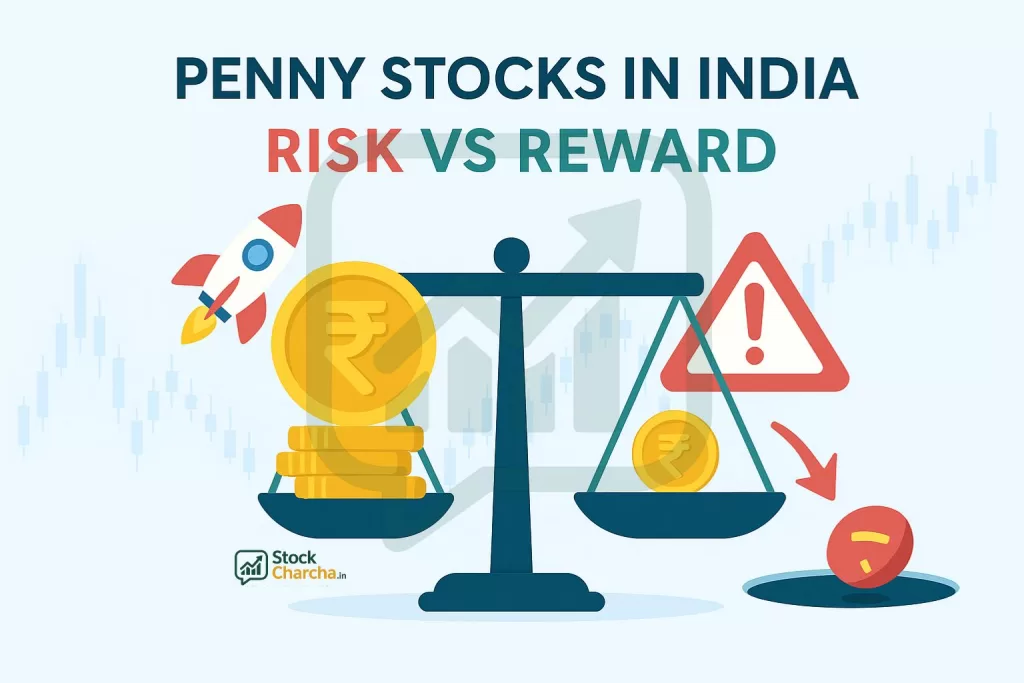
Jab maine pehli baar penny stocks ke baare me suna, maine socha “Wah, yeh toh saste wale shares he, ekdum budget-friendly!” ₹5 ya ₹10 ka stock kharidna mujhe zero-risk jaisa lagta tha.
Lekin time ke saath samajh aaya ki penny stocks India me cheap lottery tickets jaise hote he tempting zaroor, lekin bahut risky.
What Are Penny Stocks in India? 💡
India me penny stocks un chhoti companies ke shares hote he jo usually ₹10–₹20 se niche trade karte he. Zyada tar low market cap companies hoti he jinke baare me public information limited hoti he.
💡 Example: Ek aisi company jiska naam aapne kabhi nahi suna, market cap sirf ₹50 crore, aur share price ₹6 yeh hi penny stock he.
📌 Complete guide: The Truth About Penny Stocks in India: Should You Really Invest or Stay Away?.
Why People Get Attracted to Penny Stocks 🎯
- Low Price: Affordable lagta he, log bulk me kharid lete he.
- High Return Potential: Stock double ho gaya toh jackpot jaisa feel hota he.
- Stories & Tips: WhatsApp groups aur YouTube videos me hype create hota he.
Risks of Penny Stocks ⚠️
- High Volatility: Price kab upar ya neeche jump kare, koi guarantee nahi.
- Low Liquidity: Koi buyer na ho toh bechna mushkil.
- Lack of Information: Financial data limited ya outdated hota he.
- Pump-and-Dump Scams: Operators price artificially badhate he buyers ko trap karne ke liye.
Should You Invest in Penny Stocks? 🤔
Agar aap beginner ho, toh better he pehle in se door raho. Pehle stock market kaam kaise karta he yeh samjho, phir hi high-risk bets lo.
Experienced investors bhi penny stocks me sirf chhota allocation rakhte he.
💬 Key Takeaway: Penny stocks India me ₹1,000 ko ₹10,000 bana sakte he ya seedha ₹0. Beginners ke liye yeh zyada gamble hote he, investment kam. Pehle seekho, phir stable portfolio build karo.
Best Tools & Apps for Indian Stock Market Investors 📱📊

Jab maine investing shuru ki thi, main Excel sheet me stocks track karta tha, updates ke liye news channels dekhta tha, aur har trade ke liye broker ko call karta tha 😅.
Aaj technology ke wajah se, India me aise amazing stock market apps aur tools he jo investing, tracking, aur learning ko mobile phone se hi super easy bana dete he.
Top Stock Market Apps for Beginners in India 📲
Yeh kuch popular apps he jo kaafi Indian investors use karte he:
- Zerodha Kite – Clean interface, fast execution, beginners aur pros dono ke liye best.
- Groww – Simple app stocks, mutual funds, aur SIPs ke liye.
- Upstox Pro – Feature-rich, charting tools ke saath, aur competitive brokerage rates.
- Angel One – Trading ke saath advisory content ka combo.
- ET Markets – Market news, stock data, aur updates ke liye best.
📌 Complete comparison: Top 5 Stock Market Apps for Indian Investors – Reviewed & Compared 📈📱.
Research & Analysis Tools 🔍
Trading apps ke saath-saath, research aur analysis ke liye bhi tools zaroori he:
- Screener.in – Fundamental analysis aur company financials ke liye best.
- Moneycontrol – Market data, news, aur portfolio tracking ka all-rounder.
- TradingView – Technical analysis ke liye advanced charting.
Why the Right Tools Matter 🛠️
Stock market fast move karta he. Sahi investment tools hone ka matlab:
- Real-time data ke saath faster decisions
- Charts & ratios ke through better analysis
- Rumours aur unverified tips pe kam dependence
💡 Mera tip: Ek primary trading app choose karo aur 1–2 research tools rakho. Too many platforms use karoge toh sirf confuse ho jaoge.
💬 Key Takeaway: Chahe aap prices track kar rahe ho, charts study kar rahe ho, ya IPO apply kar rahe ho best stock market apps India me aapka time bachaenge, decision-making improve karenge, aur investing ko kaafi convenient bana denge.
How to Start Investing with Just ₹500 in India 💵🌱

Bahut beginners sochte he ki investing start karne ke liye lakhon rupaye chahiye. Par sach yeh he India me aap sirf ₹500 se bhi investing shuru karke apni wealth creation journey start kar sakte ho.
Maine jab apna pehla mutual fund SIP ₹500 se liya tha, baat amount ki nahi thi. Baat thi habit banane ki. Aur yahi habit time ke saath aapke paise ko grow karti he.
Why Starting Small Works 📈
- Low Pressure: Bina bade loss ka darr, aap learning pe focus kar sakte ho.
- Builds Consistency: Regular small investments discipline sikhate he.
- Power of Compounding: Chhote amounts bhi saalon me kaafi grow hote he.
💡 Example: Agar aap ₹500 monthly invest karo 10 saal ke liye at 12% returns, toh yeh ₹1 lakh+ ban sakta he bina aapko mehsoos hue.
Ways to Start Investing with ₹500 🔹
- Mutual Fund SIPs: Zyada tar fund houses ₹500/month se start karne ka option dete he.
- Fractional Investing in ETFs: Index ETFs jaise Nifty 50 me chhoti amounts se buy karo.
- Recurring Deposits (RDs): High return nahi dete, lekin saving discipline ke liye best.
📌 Full guide: How to Start Investing in Stocks in India with Just ₹500.
Steps to Begin 📝
- Free Demat & Trading Account open karo (most brokers free dete he).
- Beginner-friendly mutual fund ya ETF choose karo.
- Bank account se auto-debit SIP set karo.
- Performance 6–12 months me review karo, daily nahi.
💬 Key Takeaway: Amount matter nahi karta habit karti he. Jab aap India me chhoti amounts invest karne ka discipline master kar lete ho, tab aap apne contribution increase karke compounding ka magic dekh sakte ho.
Mutual Funds vs Direct Stocks in India 📊🤝

Jab beginners apni investing journey start karte he, pehla sawaal aksar yeh hota he “Mutual funds me invest karun ya direct stocks kharidun?” Dono options aapke paise ko grow karte he, lekin dono ka kaam karne ka tareeka bilkul alag he.
Mutual Funds in India 🪙
Mutual fund me bahut saare investors ka paisa pool karke stocks, bonds, ya dusre securities me invest kiya jata he.
Pros:
- Professional fund managers handle karte he.
- Chhoti amount me bhi diversification milta he.
- Passive, long-term investing ke liye perfect.
Cons:
- Annual expense ratio (management fee) dena padta he.
- Individual stock selection par kam control hota he.
💡 Example: ₹500 monthly ek Nifty 50 index fund me invest karke, aap top 50 Indian companies me indirect owner ban jaate ho.
Direct Stocks in India 📈
Direct stocks ka matlab he ki aap kisi company ke shares kharid ke uske partial owner ban jaate ho.
Pros:
- Full control kya kharidna, kya bechna, aap decide karte ho.
- Agar sahi stocks pick kiye toh higher returns ka chance.
Cons:
- Zyada research & monitoring ki zarurat hoti he.
- Diversification na hone par risk zyada hota he.
📌 Detailed breakdown: Mutual Funds vs Direct Stocks: Which Investment Option Is Best for You in India?.
Which Is Better for Beginners in India? 🤔
- Limited time & knowledge: Mutual funds se start karo.
- Research ka interest: Direct stocks explore karo saath me.
Bahut investors dono ka combo use karte he mutual funds stability ke liye, aur stocks growth ke liye.
💬 Key Takeaway: Mutual funds vs direct stocks ka koi universal answer nahi he. Aapki choice depend karti he aapke goals, risk appetite, aur market research me interest par.
SIP vs Lump Sum Investing in India 📆💰

Yeh sawaal har beginner ke dimaag me aata he “Har mahine fixed amount invest karun (SIP) ya ek saath saara paisa daal du (lump sum)?” Dono methods kaam karte he, lekin dono alag situations aur mindset ke liye fit hote he.
Systematic Investment Plan (SIP) 🗓️
SIP ka matlab he ki aap fixed amount regular interval me invest karte ho jaise monthly ya quarterly.
Pros:
- Investment discipline banata he.
- Market volatility ka impact kam karta he (rupee cost averaging).
- Chhoti amount se shuru karna easy ₹500 se bhi start ho sakta he.
Cons:
- Agar market start hote hi tez upar chala gaya, toh big gains miss ho sakte he.
💡 Example: ₹5,000 har mahine ek equity mutual fund me 5 saal tak invest karne se market ke ups & downs smooth ho jaate he.
Lump Sum Investing 💵
Lump sum ka matlab he ek hi baar me pura paisa invest kar dena.
Pros:
- Rising market me faayda zyada milta he.
- Agar timing sahi ho toh higher returns ka chance.
Cons:
- Market crash se pehle invest kar diya toh loss ka risk zyada hota he.
- Good market understanding aur confidence chahiye.
📌 Full comparison: SIP vs Lump Sum: Which Investment Method is Best for You in India?
Which Should Beginners Choose? 🤔
- Regular income he → SIP se start karo.
- Large sum ready he aur timing samajhte ho → Lump sum try kar sakte ho.
Bahut investors dono ka mix use karte he lump sum bonuses/savings ke liye, SIP monthly investments ke liye.
💬 Key Takeaway: SIP vs lump sum ka decision aapke cash flow, risk comfort, aur market condition par depend karta he. Beginners ke liye, SIP ek safer aur disciplined approach deta he.
How to Read Financial Statements of Indian Companies 📑🔍

Jab maine pehli baar kisi company ka annual report khola, toh laga jaise boring school ka textbook padh raha hoon pages bhar ke numbers, aur mujhe kuch samajh nahi aa raha tha 😅.
Lekin basics samajhne ke baad realise hua financial statements actually ek business ka report card hota he.
Yeh batata he ki company accha perform kar rahi he ya struggle kar rahi he.
The Three Main Financial Statements 🧾
1. Balance Sheet ⚖️
Batata he company ke paas kya assets he aur kitne liabilities (karz) he ek particular date par.
Key cheezein check karne ki:
- Debt levels kam hote toh usually better.
- Cash reserves strong liquidity ka matlab company ke paas emergencies handle karne ka capacity he.
2. Profit & Loss (P&L) Statement 📈
Yeh dikhata he ki ek period me company ne kitna kamaya (revenue) aur kitna kharch kiya (expenses).
Key cheezein check karne ki:
- Net profit growth over time steady growth achha sign he.
- Consistent revenues stable businesses kam risky hote he.
3. Cash Flow Statement 💵
Track karta he business me paisa kaise aa raha he aur kaise ja raha he.
Positive cash flow ka matlab he ki company ke paas apne operations aur growth ke liye paisa kaafi he.
Why This Matters for Indian Investors 🇮🇳
Financial statements samajh aane se aap:
- Weak financials wali companies avoid kar paoge.
- Steadily growing businesses spot kar paoge.
- Tips par depend hone ke bajaye informed decision le paoge.
📌 Full guide: How to Read Financial Statements of Indian Companies (Beginner-Friendly Guide)
💡 Mera tip: Har ek line padhne ki zarurat nahi. Bas bade numbers aur trend dekh lo clear picture mil jaayegi ki company healthy he ya nahi.
💬 Key Takeaway: Financial statements padhna ek must-have skill he. Isse aapko ekdum X-ray vision mil jaata he jisse company ki asli performance samajh aati he.
Top Stock Market Terms Every Indian Beginner Should Know 📚📈
Jab maine investing shuru ki thi, stock market ka jargon ek nayi bhasa lagta tha 🤯.
Koi bolta “Stock ne bullish candlestick banane ke baad resistance hit kiya” toh main bas haan me sir hila deta… samajh kuch nahi aata tha 😅.
Isliye yeh simple glossary bana di he, taaki aap confidently market ki baatein samajh sako.
1. Bull Market 🐂
Jab stock prices generally upar jaa rahi ho aur investors ka confidence high ho.
2. Bear Market 🐻
Jab stock prices gir rahi ho aur investors pessimistic ho jaayein.
3. Blue-Chip Stocks 💎
Bade, established aur financially strong companies ke shares.
Example: Reliance, Infosys, HDFC Bank.
4. Market Capitalization (Market Cap) 🏢
Company ke total shares ka market value.
- Large-cap → Stable, big companies
- Mid-cap → Medium size, growth potential
- Small-cap → Chhote size, high risk
5. IPO (Initial Public Offering) 🚀
Jab ek private company pehli baar public ko apne shares bechti he.
6. Dividend 💰
Company ka profit ka ek hissa jo shareholders ko diya jaata he.
7. P/E Ratio (Price-to-Earnings) 📊
Dikhata he ki investors ₹1 earning ke liye kitna pay karne ko ready he.
8. Support & Resistance 📈
Support → Price level jahaan stock girna stop karta he.
Resistance → Price level jahaan stock upar jana stop karta he.
9. Volatility ⚡
Kitni tezi se aur kitna zyada stock prices upar–neeche hoti he.
10. Liquidity 💧
Kitni aasani se koi stock buy/sell ho sakta he bina price ko zyada affect kiye.
📌 Full glossary: Top 10 Stock Market Terms Every Indian Beginner Should Know
💬 Key Takeaway: In stock market, terms samajhna matlab game ka rulebook samajhna. Phir chahe news ho, analyst report ho ya trading discussion aap confidently participate kar paoge.
Conclusion – Aaj Se Aapka Stock Market Safar Shuru 🚀📈
Agar aap yahan tak padh chuke ho, toh congratulations 🎉 aapne ab tak stock market ke basics, tools, investing mindset, aur winning strategies ka ek solid foundation bana liya he.
Ab aap jaante ho ki success yahan luck ka khel nahi he yeh knowledge, patience aur consistent action ka combination he.
💡 Yaad rakho:
- Start small ₹500 se bhi shuruaat ho sakti he.
- Keep learning market unko reward karta he jo adapt karte he.
- Avoid shortcuts “jaldi ameer banne” ke shortcuts sirf kahaniyon me hote he.
- Think long-term asli wealth saalon me banti he, dinon me nahi.
📌 Agle Kadam:
Aap yahan se apni learning ko aur deep le jaa sakte ho:
- Mutual Funds vs Direct Stocks – Kaunsa aapke style ko suit karta he?
- SIP vs Lump Sum – Kaunsa approach aapke liye best he?
- How to Read Financial Statements – Companies ka asli report card decode karna seekho.
- Top 5 Stock Market Apps in India – Apne investing tools wisely choose karo.
🌱 Mera ek investor se doosre investor ko salaah:
- Discipline ko prediction se upar rakho.
- Learning ko “hot tips” se upar rakho.
- Patience ko panic se upar rakho.
Indian stock market me opportunities ki kami nahi he aur ab aap inko pehchan ke smart decisions lene ke liye zyada tayyar ho.
💬 Aapka Number Ab: Toh batao iss guide ke baad aapka pehla step kya hoga? Kya aap ek SIP shuru karoge, Demat account open karoge, ya technical analysis seekhoge?
💬 Mera tip: FOMO se bacho, “hot tips” pe mat bhaago, aur apni pace pe seekhte hue invest karo. Market aapko reward karega agar aap discipline se chale. 🚀📈
Comments me likho mujhe aapki journey sun’ne ka intezaar rahega! 💬📈
FAQs
How can a beginner start investing in the Indian stock market?
Beginner ke liye pehla step hota he Demat aur Trading account open karna with a SEBI-registered broker. Phir aapko basic market terms aur process samajhna zaroori he. Start chhote amounts se karo, jaise ₹500–₹1000 ke shares. Bilkul waise hi jaise ek naye driver pehle empty road pe practice karta he.
Is stock market safe for beginners in India?
Stock market safe he agar aap knowledge ke saath enter karte ho. Risk tab hota he jab bina samjhe ya tips follow karke invest karte ho. NSE, BSE aur SEBI hamesha bolte he ki informed decision lena hi safest way he. Beginners ko pehle basics aur long-term investing par focus karna chahiye.
What is the minimum amount needed to start stock market investment in India?
India me stock market shuru karne ke liye koi fixed minimum amount nahi he. Aap ek share bhi buy kar sakte ho, chahe wo ₹100 ka ho ya ₹500 ka. Lekin beginners ke liye ₹500–₹1000 se start karna sahi he, taaki learning ke saath risk bhi control me rahe.
What are the best ways to learn stock market basics?
Stock market basics seekhne ke liye aap NSE India, BSE India aur SEBI ki official websites visit kar sakte ho. Online courses, books aur financial blogs bhi help karte he. Daily news aur market updates padhna habit banao – bilkul jaise fitness ke liye daily walk karna zaroori he.
Why do most beginners lose money in the stock market?
Sabse common reason he short-term trading aur tips follow karna. Beginners aksar greed me aake jaldi profit chahte he aur loss ho jaata he. Ek aur mistake hoti he portfolio diversify na karna. Long-term patience aur discipline hi successful investing ka asli mantra he ye SEBI aur AMFI bhi emphasize karte he.
Can I invest in stock market without a broker in India?
Directly stock market me invest karna possible nahi he. Aapko ek SEBI-registered broker ya stockbroking app ke through hi trade karna padta he. Broker aapko Demat aur Trading account provide karta he, jisme shares safe rehte he aur trading possible hoti he.
✍️ About the Author
This article is written by Hasanraza Ansari, founder of Stock Charcha. I simplify stock market concepts, mutual funds, and trading strategies for beginners and retail investors.
🌐 Connect with me on LinkedIn.
⚠️ Disclaimer: Content is for educational purposes only. Stock market investments involve risk. Do your own research or consult a financial advisor before investing.