I noticed something interesting on Google Trends today.
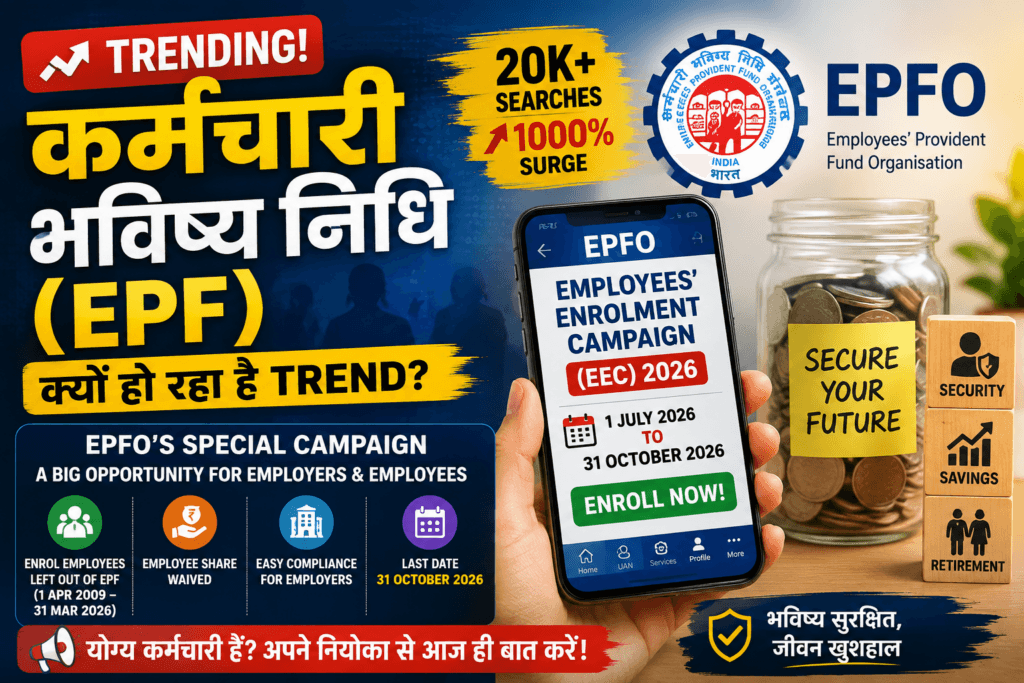
The Hindi search term “कर्मचारी भविष्य निधि”, which means Employees’ Provident Fund or EPF, has suddenly jumped to 20K+ searches with growth of more than 1,000% in the trend snapshot I checked.
That kind of spike immediately makes me curious.
Why are so many people suddenly searching for EPF?
I checked the latest government and EPFO updates, and there is a pretty clear reason behind the attention: EPFO’s Employees’ Enrolment Campaign (EEC) 2026.
This is a special, time-bound opportunity for employers to enrol eligible employees who were previously left outside EPF coverage.
And there is a deadline that matters: 31 October 2026.
So I dug into the details to understand who this applies to, what relief employers get and what employees should actually know.
Why Is कर्मचारी भविष्य निधि Trending Right Now?
The biggest reason I found is the Employees’ Enrolment Campaign 2026 launched by EPFO.
According to the Ministry of Labour & Employment, the campaign gives employers a one-time opportunity to voluntarily enrol eligible employees who were left out of EPF coverage during the period from 1 April 2009 to 31 March 2026.
The campaign became operational from 1 July 2026 and will remain open until 31 October 2026.
That is likely why the search term is suddenly attracting so much attention.
People aren’t just searching for “EPF” randomly.
There is a live government-backed campaign with a fixed deadline.
What Is the EPFO Employees’ Enrolment Campaign 2026?
In simple words, EPFO is giving eligible employers an opportunity to correct certain past gaps in employee enrolment.
If an employee was eligible for EPF but was not enrolled during the specified period, the employer can voluntarily declare and enrol that employee under the campaign, subject to the scheme’s conditions.
The campaign covers eligible employees who were left out of EPF coverage between:
1 April 2009 and 31 March 2026
And the campaign itself is available until:
31 October 2026
That makes this different from a normal EPF registration process.
It is essentially a special compliance window.
Who Can Be Enrolled Under EEC 2026?
This is where I would be careful before assuming that every employee can automatically benefit.
The campaign is aimed at eligible employees who were left out of EPF coverage during the specified period.
The employee must also satisfy the conditions under the campaign.
For example, EPFO’s July 2026 communication says an eligible employee declared under the campaign must be alive and still engaged with the establishment on the date of declaration.
So if you’re an employee wondering whether this applies to you, the first thing I would do is speak to your employer’s HR or payroll team and ask whether your employment record falls within the EEC 2026 eligibility rules.
I wouldn’t assume eligibility simply because you didn’t see EPF deductions in an old payslip.
What Benefit Does an Employee Get?
This is probably the part that caught my attention.
Under EEC 2026, where the employee’s share of contribution was not deducted from wages, that employee share is waived under the campaign.
That doesn’t mean the employee simply receives a large amount of old PF money in their account.
That’s an important distinction.
The campaign is primarily about bringing eligible employees into the EPF social-security framework and regularising past enrolment gaps.
So I wouldn’t interpret the announcement as:
“EPFO is giving everyone free old PF money.”
That’s not what the official announcement says.
What Does the Employer Have to Pay?
The financial relief is particularly important for employers.
According to the Ministry of Labour & Employment, the employer is required to remit the employer’s share of contribution, along with applicable interest and administrative charges. A lump-sum ₹100 damages amount applies under the campaign.
So the scheme is not simply wiping out every past liability.
Instead, it creates a more favourable route for eligible establishments to regularise past EPF enrolment gaps.
That could be particularly relevant for employers who have historically had eligible employees outside the EPF system.
Does the Campaign Apply to All Companies?
No.
The official announcement says the campaign applies to establishments that are covered or coverable under the EPF & MP Act, 1952 / Code on Social Security, subject to the campaign’s conditions.
So this isn’t a blanket scheme for every business in India.
Eligibility depends on the establishment and employee meeting the applicable requirements.
This is one reason I wouldn’t rely on WhatsApp messages or social-media posts claiming that “all employees can now claim old EPF.”
The official rules matter.
How Does an Employer Enrol an Employee Under EEC 2026?
EPFO says employers can complete the enrolment through the EPFO Employer Portal using the prescribed online declaration.
The process also includes digital mechanisms such as Face Authentication-based UAN generation and ECR-linked TRRN filing.
So this is not supposed to be a completely paper-based exercise.
Employers can access the official EPFO Employer Portal to check the available services.
I would strongly recommend using only official EPFO channels for this.
There is no reason to hand over your Aadhaar, UAN or other sensitive information to an unknown website just because it claims to help with an EPF enrolment.
What Is the Deadline for EEC 2026?
This is the date I would keep in bold:
31 October 2026.
The campaign started on 1 July 2026 and is scheduled to remain operational until 31 October 2026.
EPFO has also been conducting regional awareness campaigns to encourage establishments to use the window before the deadline.
So if an employer believes eligible workers were left out, waiting until the final few days probably isn’t the smartest approach.
Does This Mean Employees Will Get Their Old PF Money Immediately?
No — and I think this is where confusion could easily spread.
The EEC 2026 announcement is about enrolment and regularisation of eligible employees, not a blanket announcement of immediate historical PF payouts.
The campaign can bring an eligible employee into EPF coverage, but the actual contribution and account treatment depend on the employee’s circumstances and the applicable rules.
So if someone tells you:
“Just apply and EPFO will transfer years of PF money into your account.”
I would not trust that claim without checking the official EPFO process.
Why Is EPF Important for Employees?
For me, the bigger story here is not just the current Google Trends spike.
It is the role EPF plays in long-term financial security.
EPF creates a structured retirement savings mechanism through contributions linked to employment.
That is very different from putting money into a market-linked investment where the value can fluctuate.
This is also why I think financial education matters.
If you’re building your overall financial plan, understanding your savings, investments and long-term goals together is more useful than looking at one product in isolation.
For readers who are still learning the basics of investing, my beginner’s guide to the stock market can help explain how market-linked investments differ from traditional savings and retirement planning.
What Should Employees Do If They Think They Were Left Out?
I would keep it simple.
First, check your old salary records and employment history.
Then speak to your employer’s HR or payroll team.
Ask whether the establishment is eligible under EEC 2026 and whether your employment period falls within the campaign’s coverage.
You can also use official EPFO services to verify your UAN and employment-related information. EPFO’s member portal provides services including UAN-related facilities and member access.
If you are trying to build a broader financial plan, it can also help to understand basic budgeting and investing rather than treating EPF as your only retirement tool.
For example, I have explained the basics of evaluating financial information in my guide on how to read financial statements.
What Should Employers Do Before 31 October?
If you’re an employer and you think eligible workers may have been missed from EPF coverage, I wouldn’t leave this until October.
Start by reviewing your employee records.
Then check whether the affected employees and establishment meet the EEC 2026 conditions.
If they do, the employer can use the official EPFO Employer Portal to complete the prescribed process.
The important thing is to use the official EPFO process, keep the relevant employment records ready and understand the applicable contribution and compliance requirements before making the declaration.
So, Why Is कर्मचारी भविष्य निधि Trending Today?
After looking through the latest updates, I think the Google Trends spike makes sense.
The search term “कर्मचारी भविष्य निधि” is suddenly getting attention at a time when EPFO is running a nationwide Employees’ Enrolment Campaign 2026, with a clear deadline of 31 October 2026.
The campaign gives eligible employers a special opportunity to enrol employees who were left outside EPF coverage between 1 April 2009 and 31 March 2026, while providing specific compliance relief under the scheme.
But I wouldn’t treat this as a “free PF money” scheme.
The real story is much more practical.
It is about bringing eligible workers into the formal social-security system and giving employers a limited window to regularise past enrolment gaps.
And if you’re an employee wondering whether your name could be included, this is one of those situations where checking your records before the deadline is far more useful than simply following a trending hashtag or forwarded message.
For me, the biggest takeaway is simple:
The trend may disappear from Google tomorrow. The EPF record you build for your working life can stay with you for decades.
So if you think you may have been left outside EPF coverage, don’t chase the trend.
Check the facts. Check your records. And check with your employer before 31 October 2026.