I noticed something interesting on Google Trends today.
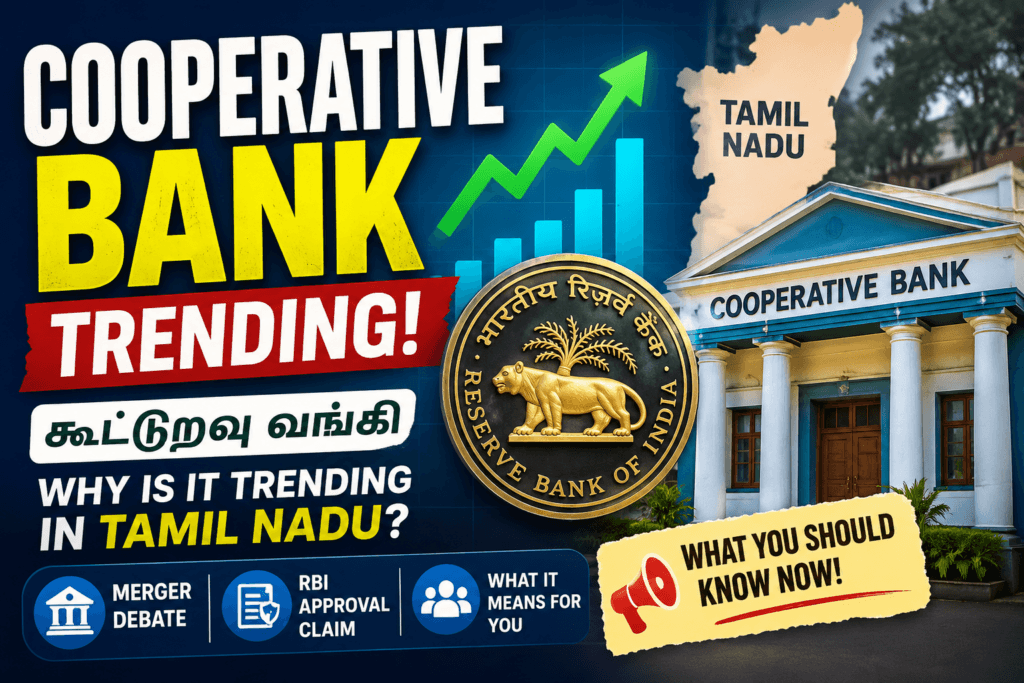
The Tamil search term “கூட்டுறவு வங்கி”, which means “cooperative bank,” has suddenly jumped to 10K+ searches with growth of more than 1,000% in the trend snapshot I checked.
Whenever I see a financial term move that quickly, my first question is simple: why is everyone suddenly searching for it?
So I dug into the latest reports.
What I found is not a story about one particular cooperative bank suddenly failing or a new bank being launched. Instead, the attention appears to be connected to a much bigger question around Tamil Nadu’s cooperative banking system, its technology, competitiveness and the long-discussed idea of consolidation.
And there is one important detail I don’t want to gloss over: some reports say the Reserve Bank of India has given approval for consolidation, but I could not find a public RBI order confirming that specific Tamil Nadu proposal.
So, rather than simply repeating the headline, I wanted to understand what is actually happening.
Why Is Cooperative Bank Suddenly Trending?
The biggest recent trigger I found is a debate over whether Tamil Nadu’s cooperative banking structure needs to become more consolidated and technologically stronger.
A recent Dinamalar report highlighted concerns raised by representatives of the Tamil Nadu Cooperative Bank Employees Federation about the ability of smaller cooperative banks to compete with large private and nationalised banks.
The report discussed a proposal to consolidate district central cooperative banks into a Tamil Nadu cooperative bank and urban cooperative banks into regional-level banks.
Another report carried a similar argument, saying cooperative-bank employees were concerned about the sector falling behind because of fragmented operations and technology gaps.
That explains why the phrase “cooperative bank” is suddenly attracting attention.
But there is more to the story.
What Actually Happened With Tamil Nadu’s Cooperative Banks?
The issue is basically about scale and technology.
Tamil Nadu has different layers of cooperative banking institutions, including the state cooperative bank, district central cooperative banks and urban cooperative banks.
The recent debate is that many of these institutions operate separately, while commercial banks have spent years investing heavily in digital banking, mobile applications, payment infrastructure and nationwide branch networks.
The concern raised by cooperative-bank representatives is that fragmentation can make it harder for smaller banks to compete.
One example mentioned in recent reporting is the difficulty of moving money between some separately operated cooperative banks and limitations around services such as IFSC-based transactions.
For a customer who has grown up with UPI, instant bank transfers and mobile banking, this is not a small issue.
Banking today is not just about having a branch near your house.
It is about whether your money can move quickly and conveniently.
Did RBI Actually Approve the Tamil Nadu Cooperative Bank Merger?
This is where I think readers need to slow down.
Some recent reports state that the RBI has given approval for restructuring or consolidation involving Tamil Nadu’s cooperative banks.
But when I checked the RBI material available publicly, I could not find an RBI notification confirming this specific Tamil Nadu consolidation.
What I could verify is that RBI has a formal regulatory framework covering amalgamation of cooperative banks. Its material specifically discusses amalgamation of District Central Cooperative Banks with State Cooperative Banks, along with separate regulatory directions for urban cooperative banks.
So I would not turn the headline claim into:
“RBI has officially approved Tamil Nadu’s cooperative bank merger.”
That would be stronger than the evidence I could verify.
For now, the safer description is that a consolidation proposal and debate are gaining attention, with reports claiming an RBI nod that I could not independently confirm from an official RBI order.
That distinction matters.
Why Does Consolidation Matter for Customers?
This is probably the most useful part of the story.
Imagine having a bank account that works perfectly inside your district but becomes less convenient when you move money across districts.
Now compare that with a large commercial bank where your account, UPI, ATM, mobile banking, NEFT and IMPS services generally work across the country.
That’s the competitive gap cooperative banks have to think about.
A larger, more integrated cooperative banking structure could potentially bring advantages such as:
- Better technology investment
- Stronger digital banking infrastructure
- Easier inter-bank transactions
- Wider customer reach
- Better ability to compete with private banks
- More standardised services
But consolidation alone does not magically solve everything.
A bigger bank can still have poor technology or weak customer service.
So for me, the real question isn’t simply “Will cooperative banks merge?”
It is:
“Can cooperative banks become technologically strong enough to compete for the next generation of customers?”
Why Are Cooperative Banks Important in Tamil Nadu?
This part is easy to overlook.
Cooperative banks are deeply connected to the real economy.
They serve customers and borrowers who may not always fit neatly into the traditional large-bank model, including farmers, small businesses, self-help groups and local borrowers.
The wider cooperative system also plays an important role in agricultural and rural credit.
The Reserve Bank distinguishes between urban cooperative banks and rural cooperative banking institutions such as State Cooperative Banks and District Central Cooperative Banks, with RBI and NABARD having different regulatory and supervisory roles across these categories.
So this isn’t simply a story about bank names changing.
It is ultimately about how easily people can access credit and banking services.
What Should Investors Understand About a Bank’s Financial Health?
This is where I think the story connects with a much broader investing lesson.
If a cooperative bank or any other financial institution becomes the subject of a major restructuring discussion, the headline alone doesn’t tell us whether the institution is financially strong or weak.
You need to look at the numbers.
Things such as profitability, asset quality, capital position and cash flows can tell a much more useful story.
That’s why I think my earlier guide on how to read financial statements of companies is useful for readers who want to understand how financial health is actually evaluated rather than simply following a headline.
The same principle applies here:
Don’t just ask what happened. Ask what the numbers are saying.
Could This Affect Depositors and Borrowers?
At this stage, I wouldn’t tell depositors to panic.
There is no verified information I found saying that customers need to withdraw money or that Tamil Nadu cooperative banks are facing a system-wide collapse.
The current discussion is primarily about structure, competitiveness, technology and consolidation.
If an actual merger or restructuring is officially announced for a particular bank, then customers should look for details about:
- Account numbers
- IFSC changes
- Branch changes
- Cheque books
- ATM/debit cards
- Loan accounts
- EMI payments
- Fixed deposits
- Digital banking access
Those are the practical issues that matter when banks are reorganised.
Until there is an official notification, I wouldn’t make assumptions.
Is This Part of a Bigger Change in India’s Banking System?
I think it is useful to look at the bigger picture.
Cooperative banking in India has been going through regulatory and structural changes, while the sector is also being pushed toward better governance, technology and financial resilience.
That makes this story interesting even for people who don’t have a cooperative-bank account.
If you’re new to financial markets and want to understand how banking developments fit into the wider financial system, I would also recommend starting with What Is the Stock Market?. It explains the basic connection between companies, investors and the financial markets in simple language.
And if you want to go one step deeper, the Charcha Knowledge Hub has more beginner-friendly finance and investing explainers.
What Am I Watching Next?
For me, this is where the story gets interesting.
I would watch for an official notification from the RBI or Tamil Nadu government that clearly explains whether any consolidation has actually been approved and, if so, which cooperative banks are involved.
I would also watch for details about the proposed structure.
Will district central cooperative banks actually become part of a larger Tamil Nadu cooperative bank?
Will urban cooperative banks be reorganised regionally?
What happens to existing customers?
What happens to branches and technology systems?
And perhaps most importantly, will the restructuring improve the customer experience?
Those answers matter far more than the Google Trends spike itself.
So, Why Is “Cooperative Bank” Trending Today?
After digging through the latest reports, my reading is pretty straightforward.
The search spike appears to be connected to renewed public attention around Tamil Nadu’s cooperative banking system, consolidation proposals and concerns about its ability to compete with larger banks.
But I would be careful with one viral-sounding part of the story.
The specific claim that RBI has already approved the Tamil Nadu merger is not something I could independently confirm from an official RBI notification.
And that’s exactly why I think this trend is worth explaining instead of simply repeating the headline.
A trending search tells me that people are curious.
It doesn’t automatically tell me that every claim surrounding that search is true.
For now, I’d watch the official notifications, the proposed structure and the technology changes very closely.
Because the real story isn’t whether a cooperative bank gets a new name.
The real story is whether the cooperative banking system can become bigger, stronger and easier to use without losing the local connection that made people trust it in the first place.
And that’s the part I’ll be watching next.
FAQs
What is a cooperative bank?
A cooperative bank is a financial institution organised on cooperative principles and serving its members/customers, often with a strong local or regional focus. In India, cooperative banks include State Cooperative Banks, District Central Cooperative Banks (DCCBs) and Urban Cooperative Banks (UCBs). RBI regulates cooperative banks carrying on banking business under the Banking Regulation Act. Read more: RBI’s overview of cooperative banking in India
Why is “Cooperative Bank” trending in Tamil Nadu?
The search term “கூட்டுறவு வங்கி” (Cooperative Bank) has seen a sharp spike in the Google Trends snapshot discussed in this article. The recent attention appears connected to the debate around restructuring and consolidation of cooperative banks in Tamil Nadu.
Is RBI merging Tamil Nadu cooperative banks?
I could not verify an official RBI notification confirming the specific Tamil Nadu merger claim discussed in recent reports. RBI does, however, have a regulatory framework for amalgamation of cooperative banks, including guidelines concerning the amalgamation of DCCBs with State Cooperative Banks. Official reference: RBI cooperative-bank amalgamation guidelines
What is a DCCB?
DCCB stands for District Central Cooperative Bank. It operates at the district level within India’s cooperative credit structure. RBI describes the short-term cooperative credit structure as having State Cooperative Banks at the state level, DCCBs at the district level and Primary Agricultural Credit Societies (PACS) at the village level.